A Christian among Humanists: A chat over Easter

 Today, Christians around the world celebrate Easter, remembering the resurrection of Jesus Christ around 2000 years ago. Although the Humanist movement and the Humanist Society in Singapore (also called HumanistSG) have occasionally been perceived as anti-religious, small numbers of Christians have been attending its events for years. Far from being ‘religious shoppers’ or confused people, these Christians are independent-minded and well-read, holding their own against both religious and non-religious standpoints. They are also passionate defenders of reason and Singapore’s secular space and are thus often supportive of many Humanist causes.

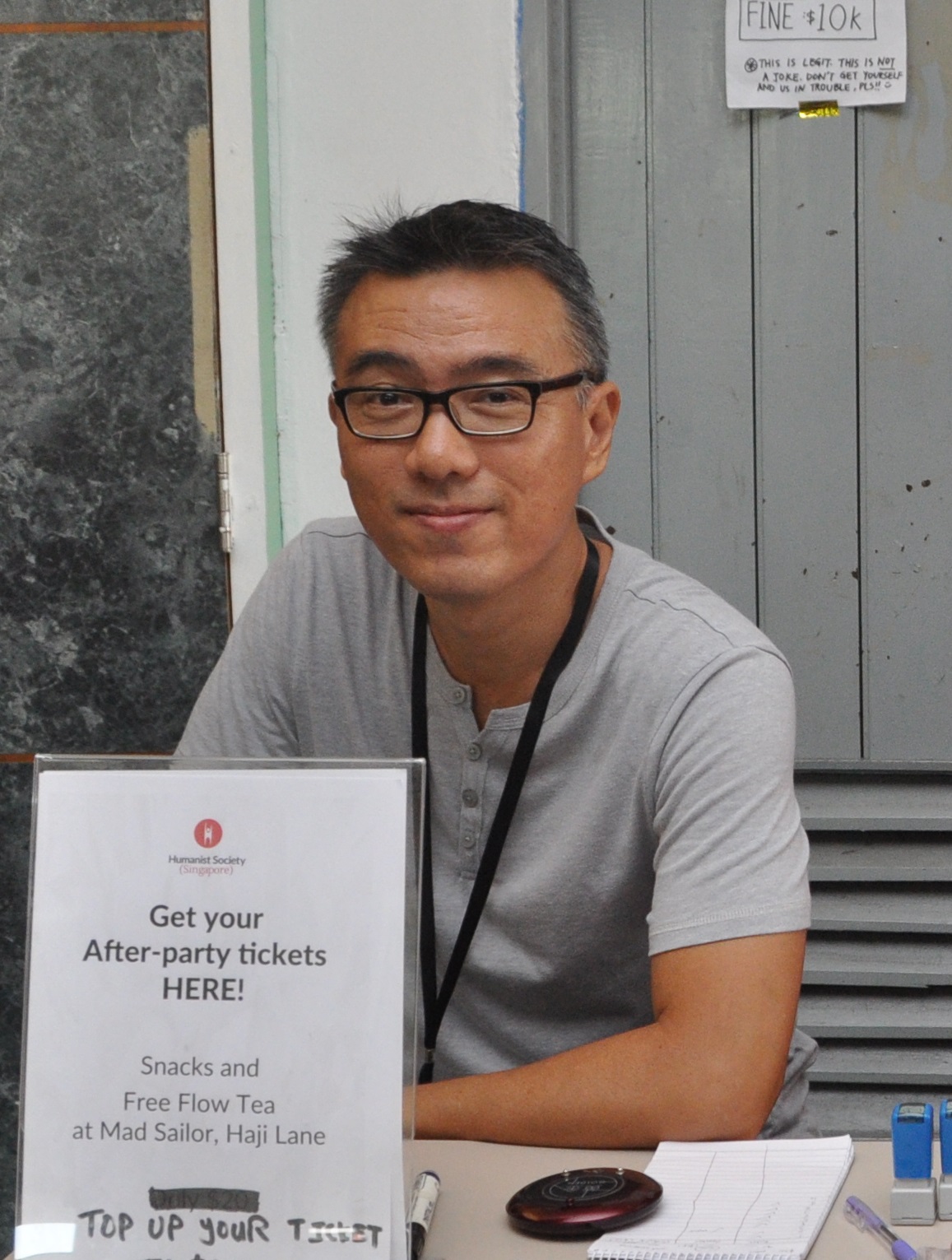
One of them is John Hui, a Singaporean Christian man in his 40s. Today, we talk to him about his eight years of experience in the Humanist movement. The viewpoints expressed are solely his own.

What is your religious belief?

John: I am a Christian. I became a Christian during my university days. It was not through other Christians’ evangelism attempts, but through my reading of books, I bought from various bookshops. At that time I found both Buddhism (not Daoism) and Christianity to be attractive (even though I was hostile towards both Buddhists and Christians who attempted to convert me to their respective worldviews) and hence I read both Buddhist and Christian books.

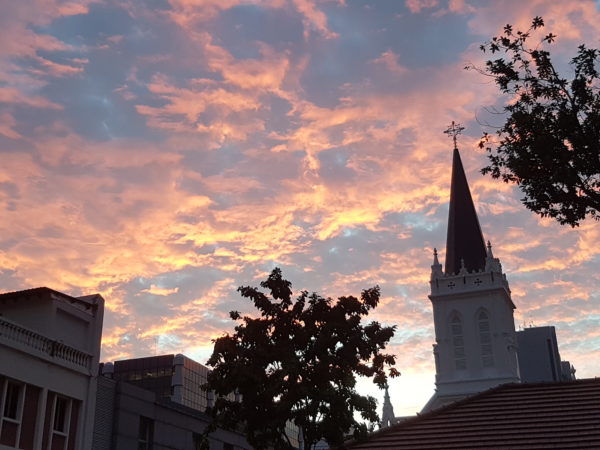
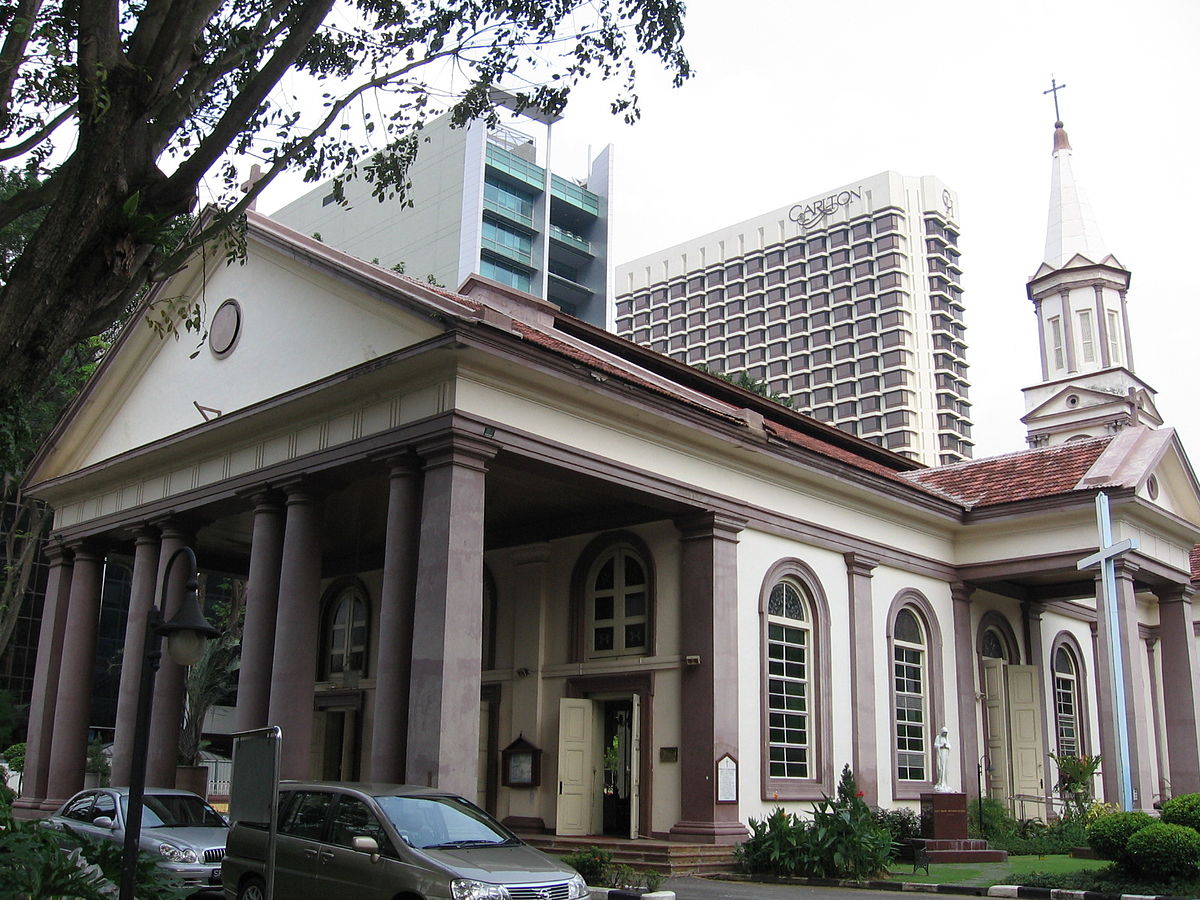
As I read I became more and more skeptical of Christianity and more and more attracted to Buddhism. However, in the end, Christianity won the tug-of-war. About one or two years after I became a Christian, I chose to join the Methodist denomination because I was impressed by the work and words of John Wesley (18th-century revivalist), the father of Methodism. Usually, I go to a handful of Methodist churches though I also enjoy participating in the Mass held in the Cathedral of the Good Shepherd (below) of the Roman Catholic Church.
How did you come to join the Humanist Society?

John: Back in 2009, I was already hoping and looking out for an organised group that can represent the non-religious in Singapore. I almost proceeded to set up one myself if not for the formation of the informal group Com.passion.com by some other persons who soon after invited me to join them (which I did). In such a context, I chanced upon an online humanist forum called the Singapore Humanism Meetup.* This online forum was run by a man called Ryan. I started participating actively in that forum. Over there and over time, I got to know a number of humanists and atheists. Some of them subsequently formed Humanist Society (Singapore) in October 2010 and I joined it as a member in November 2010.

*Admin note: The Singapore Humanism Meetup was a series of gatherings that came before the HumanistSG.

What is your first impression of humanists and atheists?

John: Very argumentative people! LOL

Have you met any hostile reactions?

John: I have not encountered any hostile reactions directed at me. I came across occasional scornful remarks but I do not consider those to be hostile.

How do you feel whenever the HumanistSG releases statements that are critical of religion? Or other religious institutions?

John: So far, those statements that I have come across are sensible statements.

Have you met other Christians or any other religious people at the Society? If yes, what do you say to them?

John: Yes, I have. If I have not already known them beforehand, I tend to ask them whether or not they believe the key content of their religious faiths. This is because I am aware that there can be atheists who identify themselves as “cultural Christians” or “cultural Buddhists” (back in 2010 I came across an atheist who identifies himself as a “cultural Christian” who attends church services regularly). Most of the handful of Christians I met in HumanistSG are believing Christians.

How did the humanists, atheists and agnostics react whenever you revealed you are a Christian? How did you respond to them?

John: Typically, they would wonder how I can be a humanist who believe in evidence-based critical reasoning and yet at the same time be a believing Christian. They would usually think that evidence-based critical reasoning contradicts Christianity. Just last week, after the Humanist Cafe (a monthly event), one atheist asked me how I managed to reconcile my Christian conviction with being a humanist. Whenever I have sufficient time to respond to such questions, I would point out a few things:

1. Historically, the earliest modern humanists were Christians and theists/deists. Humanists per se need not be non-religious. The essential elements of being a humanist per se is the adherence to humanistic values such as the promotion of human well-being base on evidence, reason, and compassion. The types of humanists include secular humanists, atheistic humanists and religious humanists (note: secular humanists is not exactly equivalent to atheistic humanists).

2. When a religious person discovers that certain elements in his religious worldviews contradict evidence-based critical reasoning, then he ought NOT continue to believe in those elements. There are elements within Christianity that I do not hold a belief in. One example would be the large scale Conquest of the Promised Land by ancient Israelites as described in some documents of the Old Testament which many Christians believe in just because they read it in the Old Testament. I do not find sufficient evidence to warrant a belief in that event.

20161210_134709

Photo above: A beautiful mural of Jesus’ birth at the St Thomas Orthodox Syrian Cathedral 

3. The essential element of Christianity is the bodily resurrection of Jesus. When I apply evidence-based critical reasoning to the data related to that alleged event (this involves (a) applying the historical-critical method to the text in the relevant ancient documents, (b) using abductive reasoning or inference to the best explanation, (c) employing Occam’s Razor, (d) differentiating between a-posteriori probability and apriori probability, and (e) giving a sceptical treatment of the data by intentionally searching for my intellectual blindspots, i.e. actively seeking reasons and evidence to reject the resurrection, such as by stepping into the perspectives of various well-established atheistic scholars in the relevant fields who argued against that resurrection), I find it likely that Jesus’ bodily resurrection really happened in history. Like scientific theories, this conclusion of mine is held as a tentative conclusion. If new evidence arises such that it warrants a change or a modification of the conclusion, I will change my conclusion accordingly. In other words, I will let evidence-based critical reasoning shape my conclusion.

4. If Jesus indeed was bodily resurrected from the dead, then Jesus would have earned the credential for me to take him seriously in what he taught and did. This implies that his theistic worldview is probably correct, at least in the essentials. Of course, the attempt to discern what Jesus taught and did 2000 years ago is not a straightforward bible-reading affair. We would need to apply scholarly tools to the text in the relevant ancient documents to differentiate between what he probably taught from words that might have been put into his mouth, and between what he probably did from actions that might have been fictionally created. So evidence-based critical reasoning is also needed in determining what Jesus probably said and did, even if one were to be convinced that Jesus was the person qualified to teach us about God and about the telos of our existence.

5. It does not mean one is not rational in not believing in Jesus’ resurrection. As long as one has applied critical reasoning properly, one is rational to believe or not to believe in Jesus’ bodily resurrection. In other words, given the data, philosophically speaking, believing in Jesus’ resurrection is “rationally allowed” and not “rationally required”. The reverse is also true: not believing in Jesus’ resurrection is “rationally allowed” and not “rationally required”.

What kept you going at the Society? What value-add does it provide for you?

John: I just find it worthwhile to support a group that caters to the well-being of the non-religious. What has been lacking for a very long time in Singapore is a formal organisation that promotes the well-being of the non-religious and voice out for them AS AN ORGANISATION in our pluralistic society. There is a great imbalance of influence between the religious and the non-religious persons in the public sphere because the former persons have many organisations that voice out for them while the latter do not.
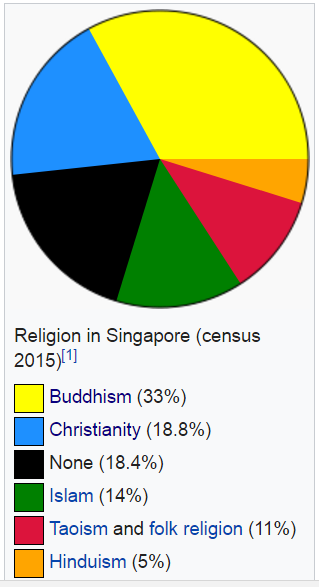
Given that a 2015 survey reported in the newspapers informed us that the percentage of non-religious people is roughly equal to the percentage of Christians in Singapore, it is important that HumanistSG exists to contribute a public voice for the non-religious especially in situations where the religious organisations (especially Christian groups) sought to publicly influence society with their religion-based values which might contradict some values of the non-religious (note: the non-religious people includes both atheists and people who have supernatural beliefs).

Among the humanists, what are the types of people you get along well with?

John: Those who can reason well, regardless whether or not they have different convictions from me in any issue. I place a lot of weight on the reasoning process rather than the conclusions. I am not bothered by people having different conclusions as long as they arrived at their conclusions via proper critical reasoning. Critical reasoning can lead to more than one rationally allowed conclusions, even contradicting conclusions.

Overall, how does the environment in the Humanist Society compare to that of a church?

John: Difference: In churches, things are more organised and proportionately more people are more willing to sacrifice their time and put in their effort, even over the long-term, to meet the various needs of the churches.

Similarity: The presence of people who are intellectually arrogant and overconfident in their respective worldviews as if theirs is the only rational option while all other positions are irrational.

On the Christian side, there are many overconfident and arrogant people who failed to see the fallacies of their apologetic arguments for their religious worldview. The same occurs on the atheist side. Such people failed to take seriously their fallibility and susceptibility to having intellectual blindspots. They do not actively search for their intellectual blindspots nor do they seek to really understand the intellectual grounds of those worldviews that contradict their own worldview when they criticise the rationality of the other worldviews.

Often their understanding of others’ worldviews is only a caricature and often what they manage to criticize are only strawmen build by themselves and not the real arguments of the competent deep thinkers of other worldviews. They overestimate the intellectual strength of their own worldview while simultaneously underestimate the intellectual strength of the opposing worldviews.

Since most of the readers of this interview are likely to be atheists, I would like to quote here the words of atheist philosopher of religion Quentin Smith:

“The great majority of naturalist philosophers have an unjustified belief that naturalism is true and an unjustified belief that theism (or supernaturalism) is false…the vast majority of naturalist philosophers have come to hold (since the late 1960s) an unjustified belief in naturalism. Their justifications have been defeated by arguments developed by theistic philosophers, and now naturalist philosophers, for the most part, live in darkness about the justification for naturalism. They may have a true belief in naturalism, but they have no knowledge that naturalism is true since they do not have an undefeated justification for their belief. If naturalism is true, then their belief in naturalism is accidentally true.”

– The Metaphilosophy of Naturalism,” Philo: A Journal of Philosophy(Fall-Winter 2001)

In your opinion, what are the greatest strengths and weaknesses of the Humanist Society?

John: Greatest strength: Its emphasis on the use of evidence-based critical reasoning. Greatest weakness: The lack of sizeable active members contributing to meet the various needs of HumanistSG.

Should one day, a humanist or atheist gets arrested due to police reports filed by offended religious people, how would you respond?

John: I would see the merits of the specific case to determine the type and level of response I should give. If the case warrants it (e.g. if the religious people are offended due to their own fault for being intolerant of a justified critique in an academic tone), I probably would write a letter to the relevant party to voice my opinion (e.g. the complaints were unjustified).

How long do you see yourself coming to Humanist Society events, and why?

John: As long as (a) HumanistSG events continue to be appealing or (b) HumanistSG is weak and needs my support. And of course, implicitly, as long as I am able to.

How do you think the Humanist Society can be of help to the more progressive religious people?

John: Within the context of my response to this question, I need to clarify how I use these two terms: “progressive religious people” and “religious fundamentalists”.

Here, I define “progressive religious people” as those religious people, regardless of whether they are having conservative or liberal beliefs and values, who respect others’ share of our pluralistic public space to live out different beliefs and values, including beliefs and values opposite to theirs, as long as those beliefs and values do not cause professionally-recognised empirical harm to people.

I define “religious fundamentalists” as those religious people who (a) do not respect others’ share of our pluralistic public space to live out different or opposite beliefs and values, and (b) seek to reduce or remove others’ share of that public space to live out their different or opposite beliefs and values.

The HumanistSG can help such progressive religious people to build up their strength to counteract against religious fundamentalists.
Young Humanist SG Meeting #4: Setting up a resource centre

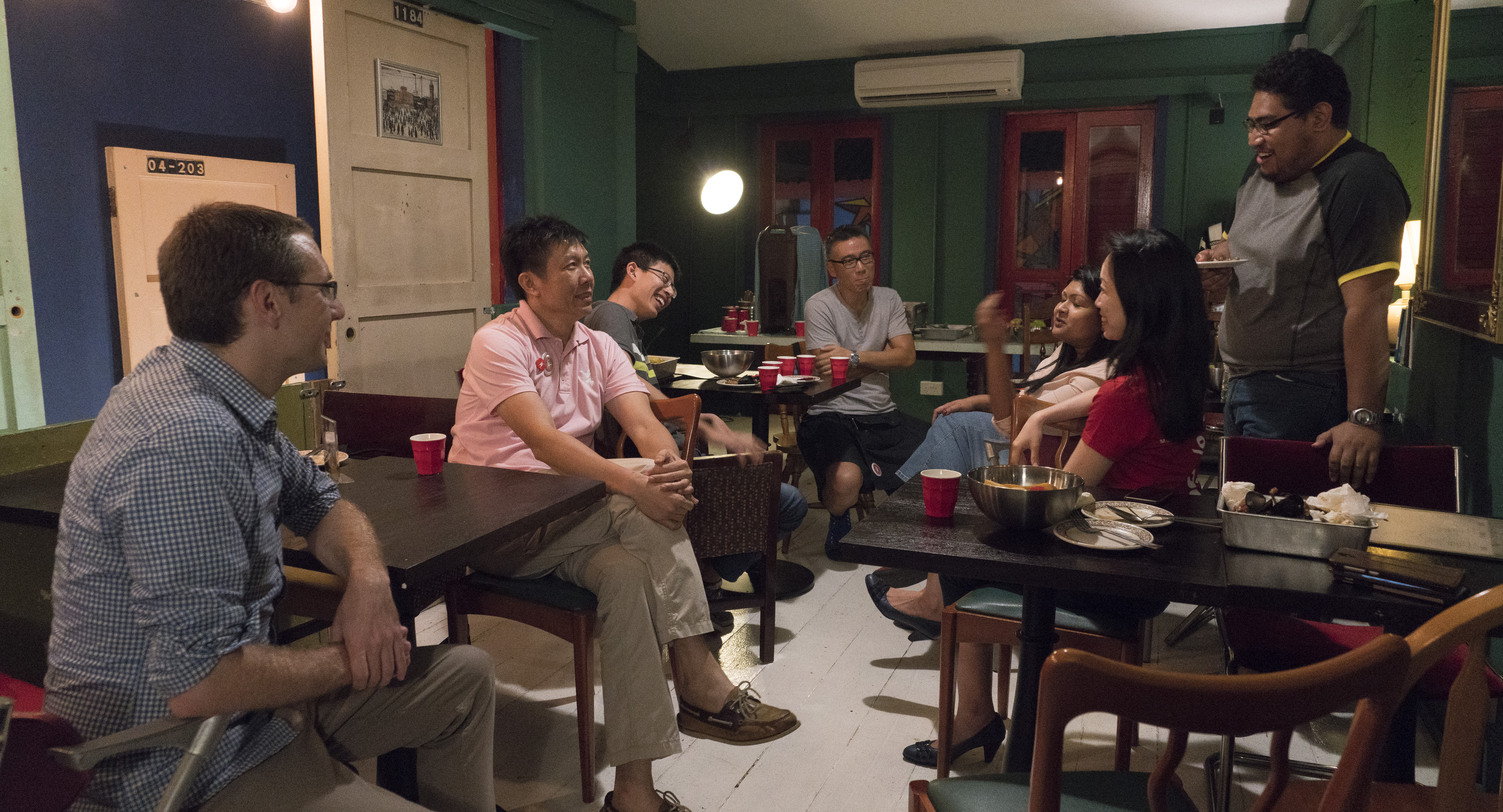
We held a lunch networking session today to discuss the Humanist Society’s plans of setting up a resource centre. The resource centre aims to provide support for non-religious people in distress. We opened the meeting to people from all ages and all walks of life. About 20 people attended the discussions, held at Safra Toa Payoh.

In February, the Humanist Society placed an advertised Facebook post calling for resource centre suggestions. Many of those who responded wanted the centre to provide support in the form of counselling, meditation, temporary shelters and conflict resolution. They were also looking for a space to provide learning opportunities, such as establishing a small library with a dedicated list of books, holding workshops / classes and providing free tuition for low-income families. Others even suggested holding celebrant services, other interest group activities, and sharing a physical place with other NGOs,

Following the Facebook post, the Humanist Society held internal discussions with educators, psychologists and social workers within our network. We concluded that the Society should not replicate existing professional services. We should instead complement professional services by providing informal support in the form of first responders. Some have pointed to existing practices in religious institutions and NGOs. For example, a trained professional can provide basic training to first responders who could then escalate a serious case to professional help when needed. This is an existing model the Society can take up. These first responders do not provide solutions. They only act as a listening ear.

At today’s discussion, the 20 participants broke up into 3 separate discussion groups to discuss the next steps. The first group proposed that the resource centre could start with a tighter list of items, instead of trying to fulfill all requests gathered from the Facebook post at once. It can start with establishing a small team of first-responders and provide a listening ear to anyone who feels troubled.

The first group felt that great care must be taken to explain the resource centre’s purpose, striking a balance between being specific (and searchable in Google) and what is acceptable to the general public. It should not be discreet because we are not doing anything illegal. At the same time, it cannot be antagonistic because it could attract the wrong type of volunteers and draw public backlash in a conservative country. There was also some debate about whether to keep the resource centre religion-neutral, or whether the Humanist Society — as a civil society and not a public service — should stay true to its original purpose and focus on helping the non-religious. One way to frame the resource centre, the first group concluded, was to describe it as a place for people “exploring non-religious alternatives to meaning in life.”

The second group discussed methods to seek funding. Establishing a resource centre would require some money and a good fundraiser is needed to drive the Society’s fundraising efforts. Once the funds are secured, the Society could look at temporary places to stay, such as hostels and backpacker hostels. The second group said it is important to present ourselves as a diverse community with different beliefs.

The third group noted that the Humanist Society currently lacks the expertise to provide such support. It suggested that in the meantime, it can rely on support in online forums. Although such forums already exist, they are very scattered and perhaps one dedicated forum could be set up to address people seeking psychological and social support. The third group also said that information for people seeking help should be made easily available online.

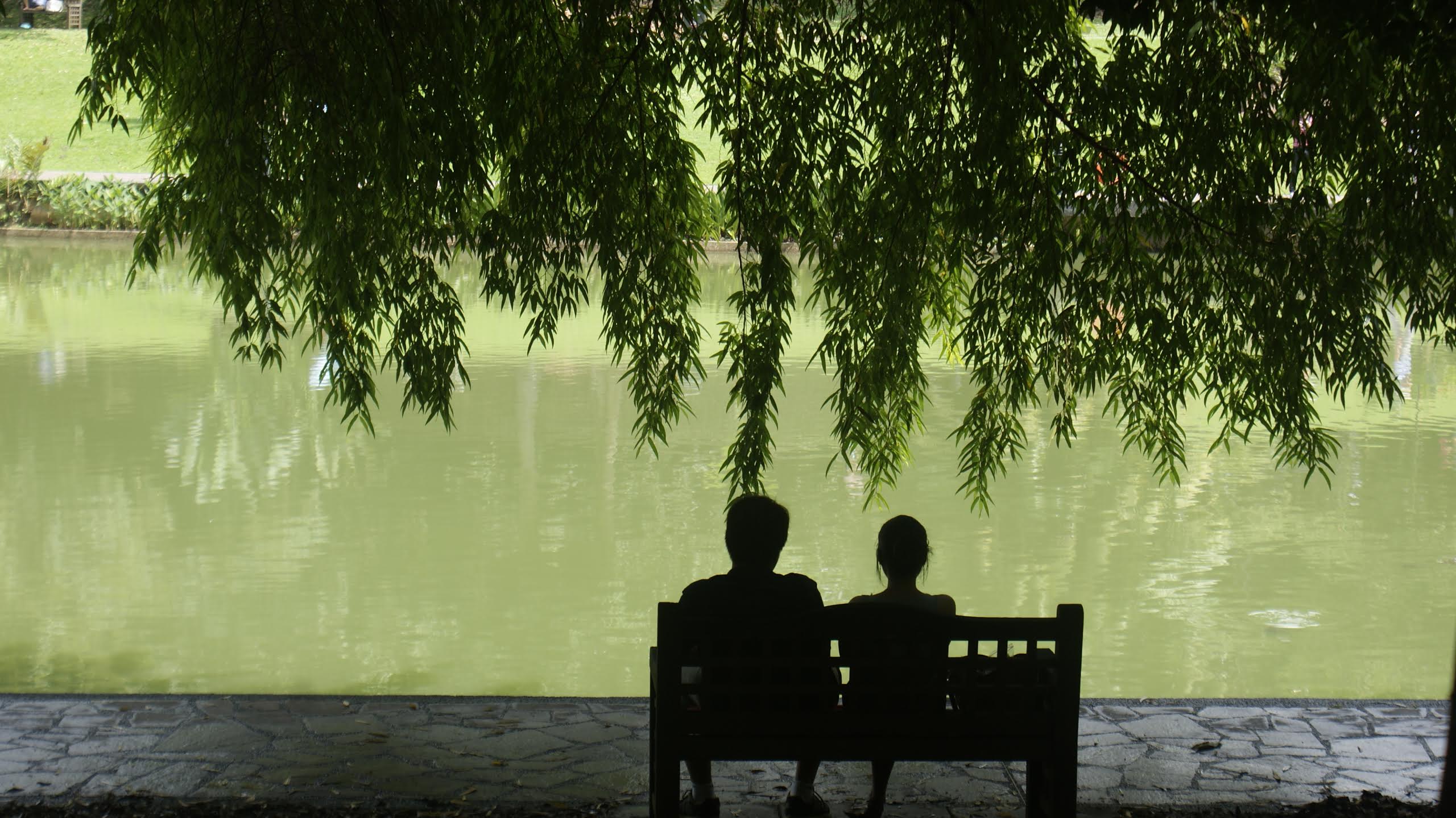
The first group also argued that online counselling could form the bulk of support efforts. A physical face-to-face meetup can be held, “friendship bench” style (see more above), at a central location such as the Hanis Cafe at NLB in town. After the initial contact has been made, the first responder can follow up with a mixture of online and physical engagement. Such an arrangement can ease the workload of first-responders who are unpaid volunteers with day jobs.

At the end of our discussion, a total of 10 people signed up to be first responders for our resource centre. We will be continuing more discussions in the months ahead, refining our purpose and generating more action items. If you have any suggestions for us, please contact us at info@humanist.org.sg

Humanists at CRIX Interfaith dialogue

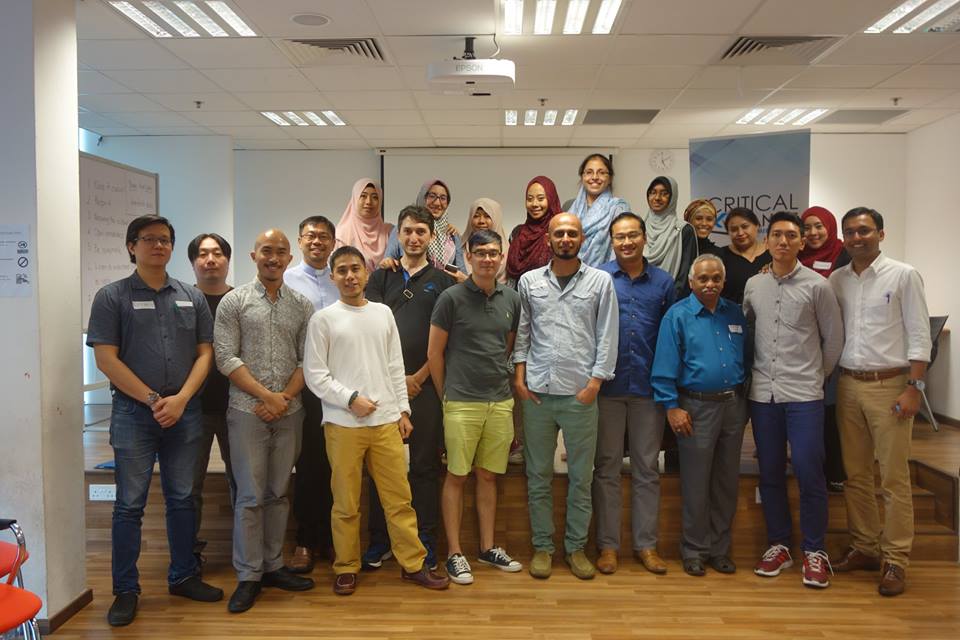
Photo above: Two of our representatives (far left) at the ‘Roadmap for Interfaith Action’ interfaith dialogue’ organized by Critical Xchange (CRIX) last week. Photo by CRIX.

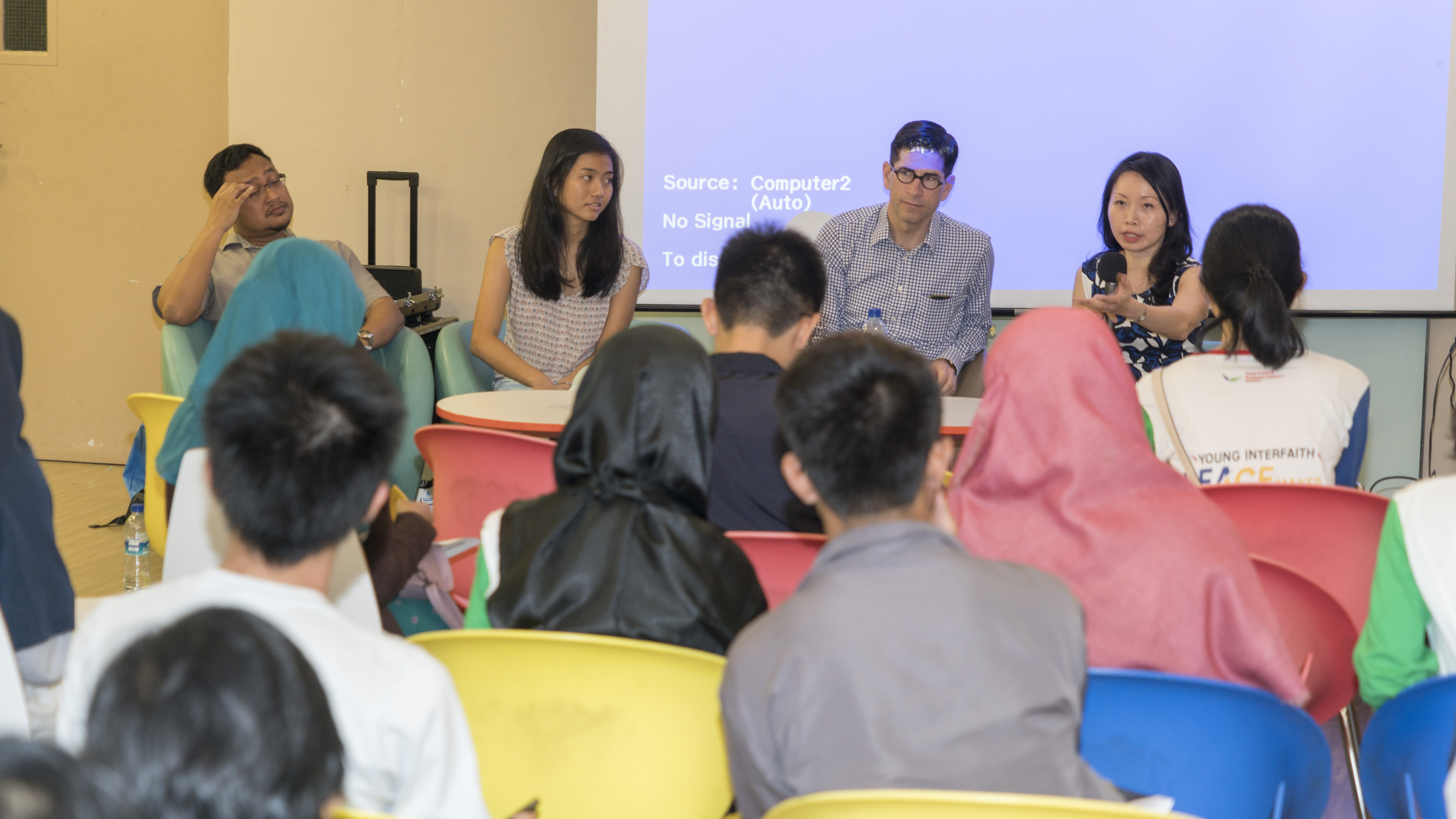
On Feb 12, 2017, the Humanist Society (Singapore) sent two representatives (far left) to a dialogue called ‘Roadmap to Interfaith Action’, organised by Critical Xchange (CRIX). The dialogue engaged faith leaders from various faith organisations and communities in Singapore and selected youth faith leaders. [Read more…]

Our Darwin Day 2017: In the Footsteps of Wallace

The Wallace Trail at Bukit Timah is named in honour of Alfred Russel Wallace, the British naturalist who independently conceived the theory of evolution through natural selection. He visited Singapore many times from 1854 – 1862 as part of his eight-year stay in the Malay archipelago. To get closer to the remaining primary forests, Wallace stayed with a French Roman Catholic missionary at St Joseph’s in Bukit Timah district. During his time in Singapore, Wallace trekked daily into the hilltops and collected thousands of insects and birds.

[Read more…]

HumanistSG Interfaith Work in NUS

The Humanist Society (Singapore) has taken part in dialogues organised by the National University of Singapore Interfaith student group. As of 2017, the Society has participated in three dialogues (2012, 2013 and 2017).

NUS Interfaith was founded in 2005 as a group of individuals from various religious and non-religious backgrounds. It aims to foster deeper understanding and appreciation through interfaith activities. Alongside the government-led Explorations into Faith (EiF) programme, NUS Interfaith was one of the first interfaith groups in Singapore to recognise the lack of non-religious representatives in the interfaith sphere.

NUS Interfaith first approached the Humanist Society in October 2011 while searching for non-religious voices into the ‘Faith First: Introduction to Religion” Dialogue Series. The series was part of an effort to promote awareness regarding diverse culture and belief systems to the NUS student population. NUS interfaith leaders Gwyneth and Wai Kit felt that the inter-faith scene lacks the humanist perspective.

The dialogue was eventually held on March 5, 2012, at Seminar Room 1 at Cinnamon College South Learn Lobe, within the NUS’ new University Town. Humanist Society representatives also met with students from the Facebook group “NUS students for Freethought” for dinner at the Koufu foodcourt.

Photos below: Our first interfaith dialogue in NUS

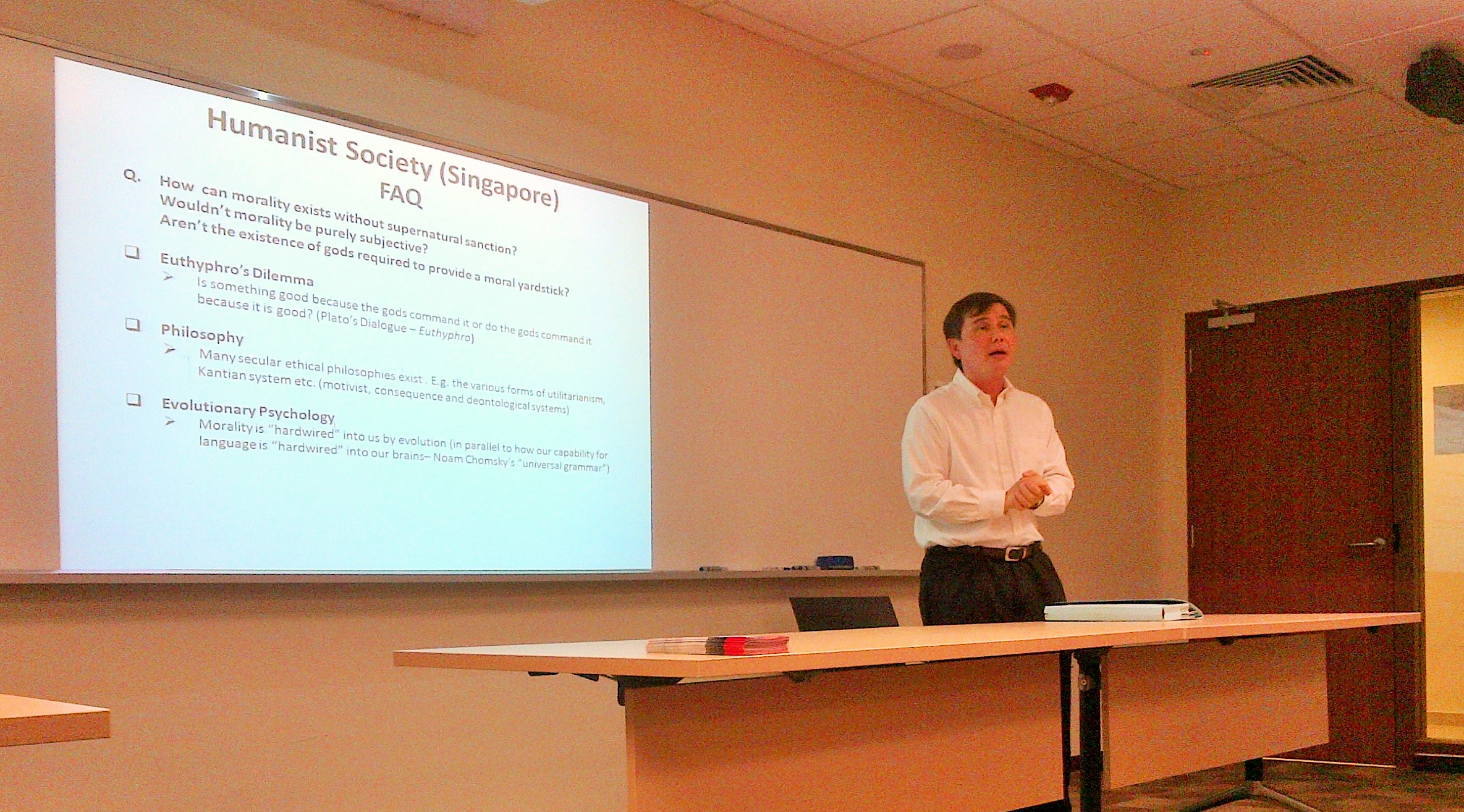
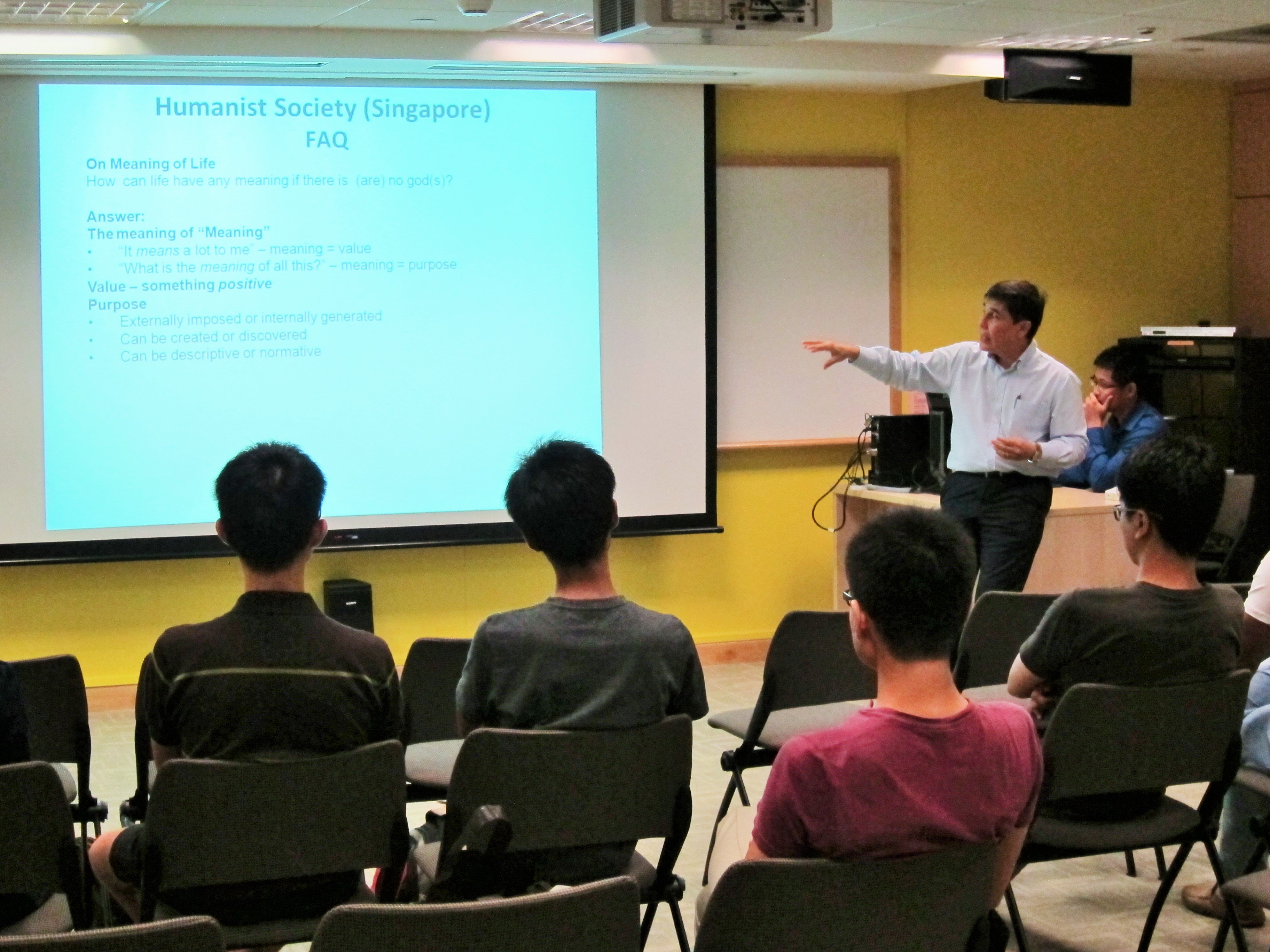
Then-President Paul Tobin gave a presentation, introducing our Society and the basics of humanism. Paul was supported by key members of the Society, including future President Mark Kwan and treasurer Eugene Tay. During the dialogue, we received many questions from the audience.

Photos below: Slides from Paul’s presentation

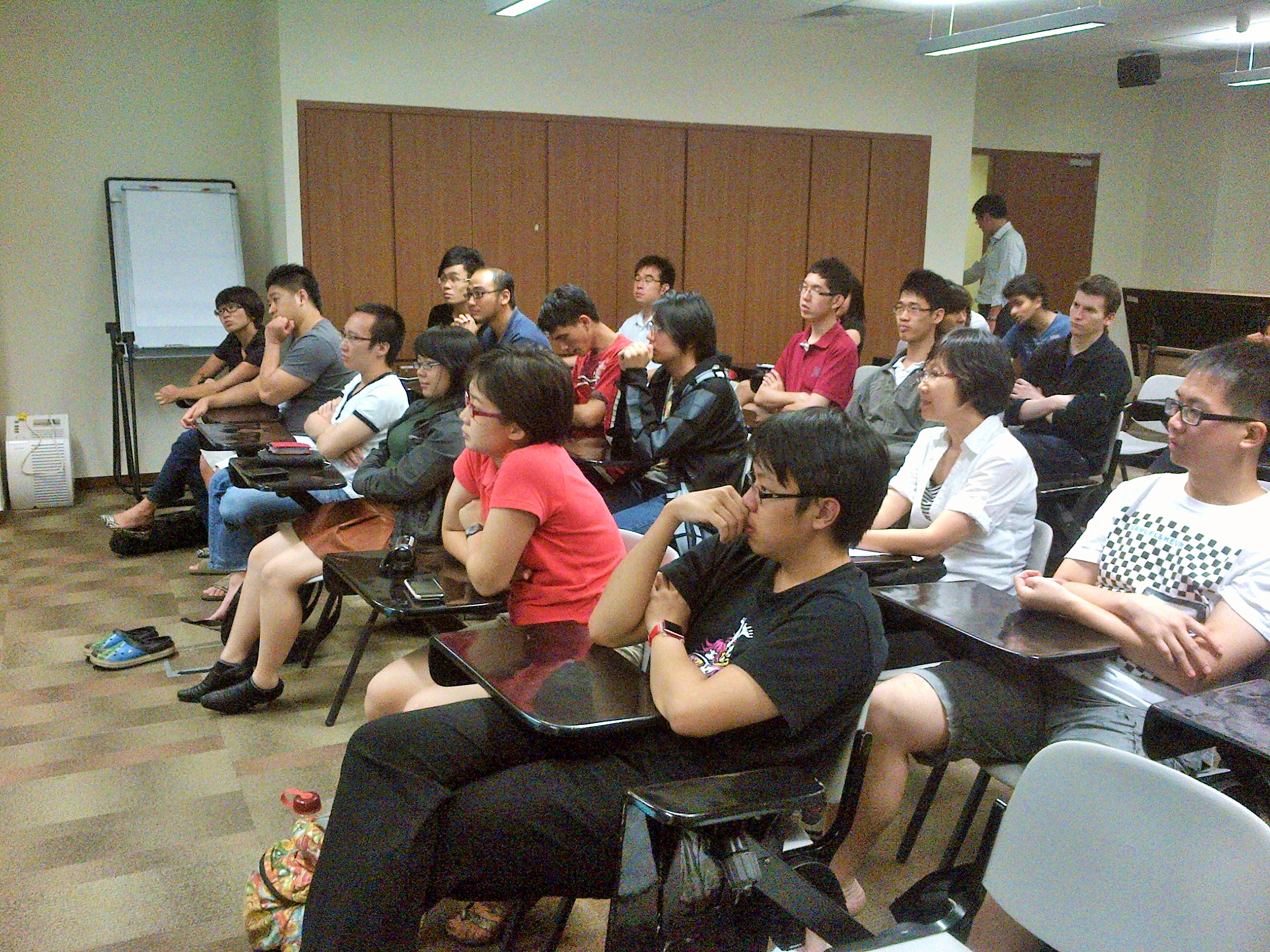
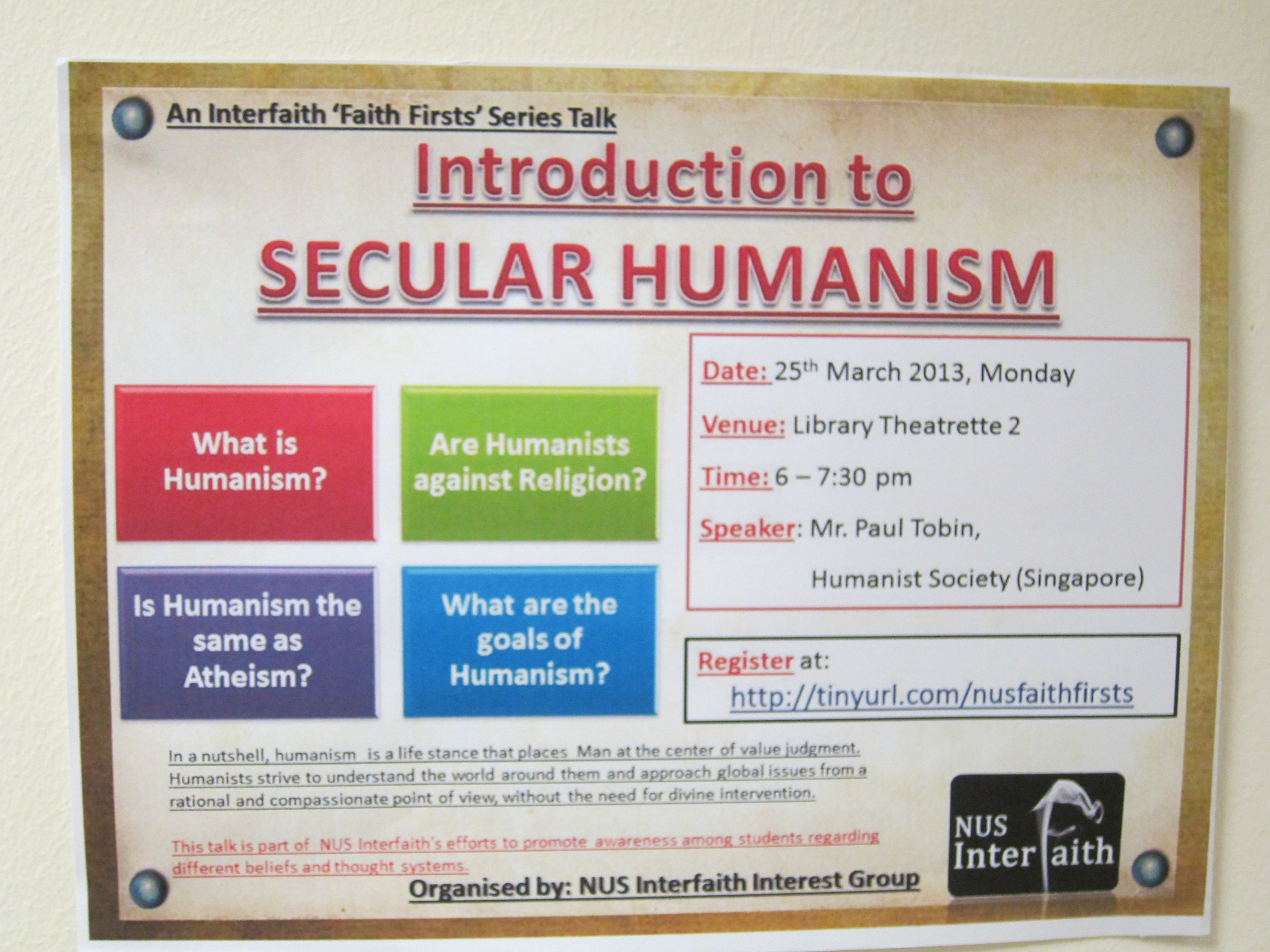
The following year, NUS Interfaith president Nur Nasuha invited the Humanist Society for a second presentation, also under the “Faith First: Introduction to Religion” Dialogue Series. NUS Interfaith believed that many students, both of religious or non-religious backgrounds, still do not know enough about secular humanism . The talk was held on March 18, 2013, at Library Thearette 1, NUS Central Library. The dialogue consisted of a 45-50 minute talk followed by a 30-35 minute QnA session:

Although the Humanist Society did not hold any interfaith dialogues in NUS from 2014-2016, interfaith efforts on other fronts increased. For example, we gave introductory lectures about humanism to EiF facilitators on 14 Sept 2014, and Aug 28, 2016. We also joined UnConference interfaith dialogues at NYGH. We also collaborated with a student group from Nanyang Technological University, called PATHS, which was working on a campaign on promoting interfaith dialogue among youth. 

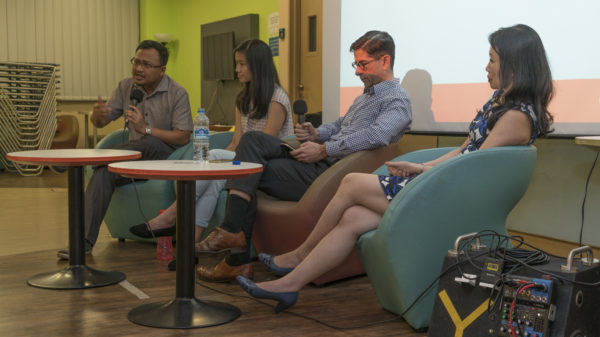
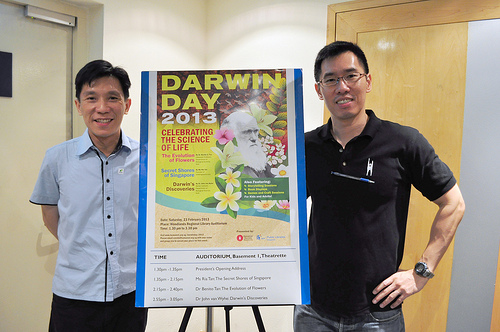
Through the efforts of humanist students at NUS Interfaith, the Humanist Society was invited to the third dialogue at NUS Yusof Ishak House, on February 8, 2017. The dialogue was well-organised and moderated by a faculty member, Dr. John van Wyhe. Our Society’s representative, Huifen, introduced the Humanist Society and engaged in a dialogue with interfaith activist Mohamed Imran Mohamed Taib.

The 2017 dialogue

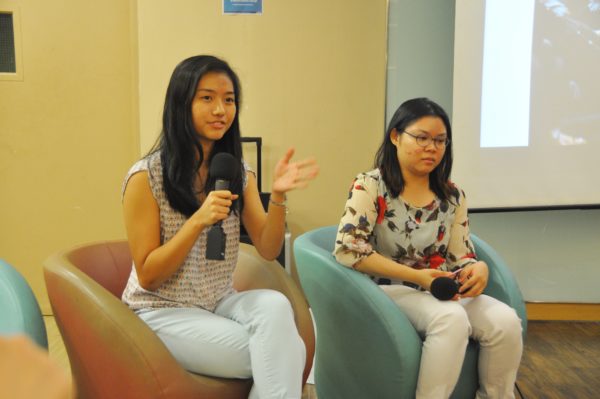
During the opening presentations, NUS student Ashley Toh (above), shared her experience as a former Christian and how the humanist community provided a support during her transition out of religion, which she described as the feeling that her world was “crumbling away”. She also responded to questions about a Tembusu College atheist film screening she co-organised with a Christian schoolmate last year.

Interfaith activist Mohamed Imran Mohamed Taib argued that both the religious and the non-religious are not monolithic groups and there is a need to appreciate the diversity within them. He shared briefly about his journey from a fundamentalist to a Muslim humanist, the false dichotomy between religion and reason, and how religious humanism (Christian and Islamic humanism) has contributed to the modern world today.

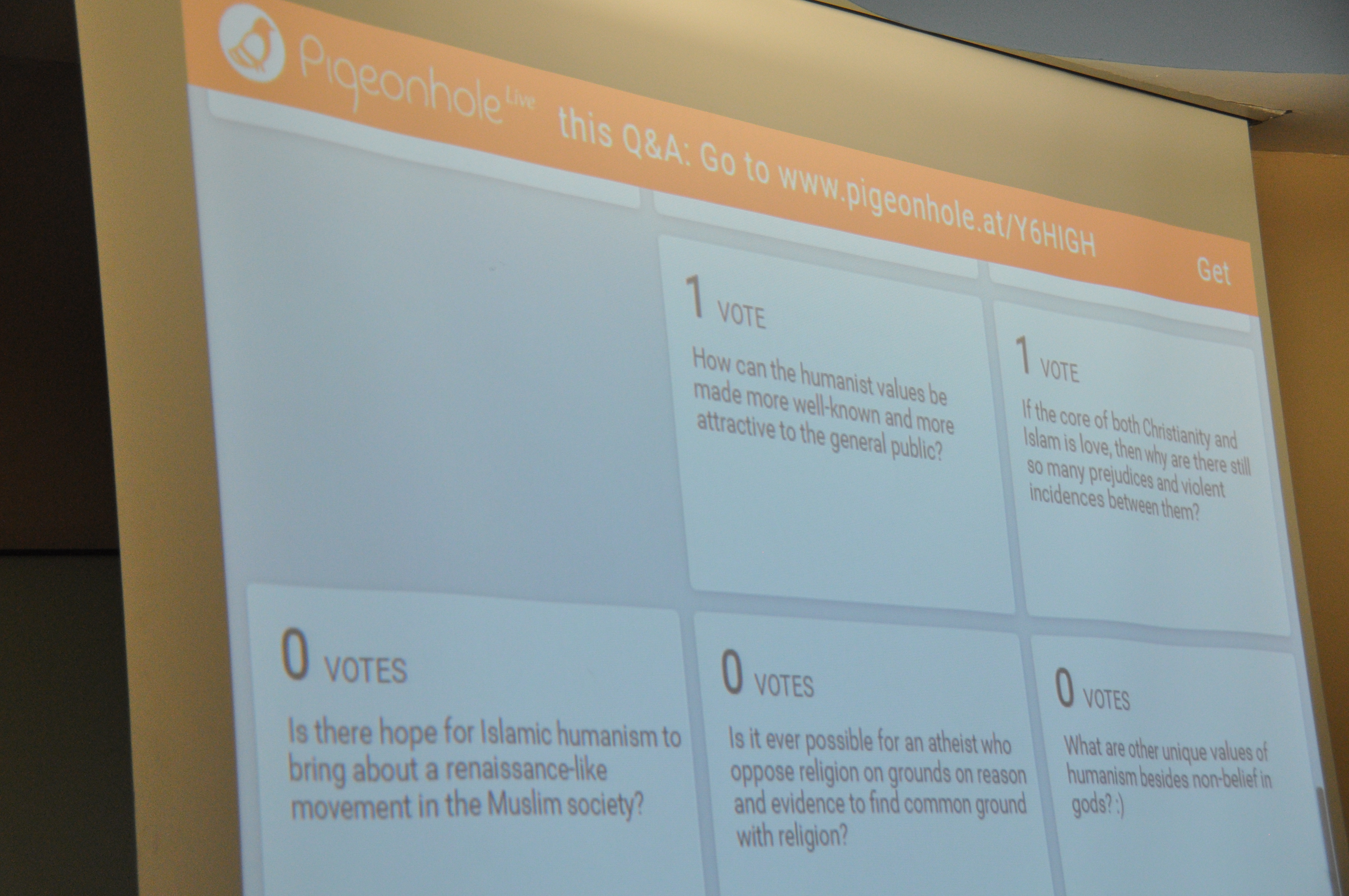
The QnA session was conducted in a very hi-tech manner. Audience members logged into a website and wrote questions which were featured on the screen. The moderator, Dr John van Wyhe, will then pick the questions to be asked. More than 20 questions were posted.

Dr John van Wyhe moderated the one-hour QnA session. Some of the opening questions include: 1) Why are non-believers considered more threatening than other religious believers? 2) The challenge that de facto “blasphemy” laws pose to the humanist movement.

On 1) Imran said that humanity always had a religion and it takes time for multiple layers of diversity to get accepted. Atheism is still quite new to the public eye and that is why people are still uncomfortable with it. Huifen, however, said that atheism has a very ancient past, with many philosophers even predating Christianity.

On 2) Huifen said that some of these laws could hurt the interfaith movement because people are not able to share thoughts candidly with each other. She felt it was better to let some disagreements be aired in public and resolved.

Imran (left) noted that even in free countries there are existing hate speech laws. However, he felt that laws based on religious offence can be problematic and used arbitrarily. There is also the danger of “hate spin” as mentioned by Cherian George, where groups of people deliberately take offence at perceived offences to mobilise public support for certain agendas.

The question on “the ideal state that humanists are trying to achieve” sparked a discussion over the limits of proselytisation. Ashley wanted a society where proselytisers respect boundaries, instead of aggressively trying to convert others all the time. Helping to clarify her thoughts, Dr van Wyhe described it as a society where humanists and secular people are recognised as equals, instead of being an “unoccupied square on the chess board.”

In response, Imran said that the right to proselytise is allowed under the Singapore Constitution, and to tell others that proselytisation is not allowed will be hard. In response, Huifen asked if that meant non-religious people have the right to speak their mind on religious matters too. Imran believes that non-religious people do have that right, pointing to the presence of books by Dawkins and Hitchens in bookstores.

Photos below: Imran (left) is a practising Muslim but he has spoken up regularly about the need to engage the non-religious in interfaith dialogue.

Many tougher questions followed from the audience. Some questions include 1) Any negative reactions towards Imran on identifying himself as a Muslim humanist 2) the point of interfaith dialogue, given the fact that some religions will always put down other religions, 3) On how humanists deal with suffering.

Imran said there is diversity within Islam and the moment one claims that there is only one Islam, the person is moving towards fundamentalism. On religions putting down others, Imran said that such teachings do exist but there are others who disagree with them. Religion is also always evolving, he added. On interfaith dialogues, Huifen said they are important because it gets people to meet and see each other. On the question of dealing with suffering, Huifen says she draws some insights from Buddhism, on how being more detached, objective and stoic can help you cope with the ups and downs of life.


Superhero no more

Alvin Phua joined the Jehovah Witness (JW) denomination as a child. Many years after, he left the faith and eventually became an atheist. He also started a bar called the Public House and it became a popular gathering place for the local sceptic and humanist movement. In 2013, Alvin spoke about his experience at a Humanist Society event. Here is his story:

[Read more…]

Young Humanists SG meeting #3: Providing pastoral care

Feb 18, 2017

After Darwin Day, Young Humanist SG organised another meeting to discuss about the need to develop pastoral care services for students on school campuses. The main points discussed:

[Read more…]

Organising Humanism: Engaging people at events

At least 70% of human communication takes place in the non-verbal form, and face-to-face. An organisation that is well-presented online still needs to ensure that participants have a good experience at their events.

At Humanist Society events, Exco members should make an effort to touch base with newcomers.  Excos should introduce themselves and the Society with confidence.

Some ways to start a conversation with a Humanist newcomer: 

  1. If the newcomer is alone, greet the person confidently and shake his/her hand (proper grip is important).
  2. Introduce your name and ask about the newcomer’s name.
  3. Ask if his/her first time here, and how did he/she find out about the Society (this helps you get a sense of where your message is going).
  4. Ask “what do you do?” instead of “where do you study or work”.
  5. If the person is within a group, gradually slide into the group. Smile and listen.
  6. Listen to the conversation and carefully find an opportunity to add a point. Do not interrupt the conversation forcefully.
  7. Whenever you have opportunities, as an exco, give a quick overview of the Society to the newcomer. Perhaps 5-10 lines. Introduce the main figures running the Society.
  8. Do not let the person enter and leave the HSS without seeing the big picture and knowing the main folks in charge. The newcomer could be meeting people who are not representative of the Society and getting a wrong impression.

Humans of HumanistSG

DSC_0279

Who is behind the Humanist Society? What kind of people are they?  What are their respective roles in keeping the humanist movement alive? Our executive committee members share some of their thoughts here!

If you are inspired to contribute to the HumanistSG like we did, you can easily do so! Membership is free for students and retirees gets 50% discount! Join us today!

If you are already a member, you should nominate an existing member for office before the Annual General Meeting, which happens every year around March.


The Assistant Secretary and handyman

Chee Hoew here. I’m Assistant Secretary at HumanistSG, and also the resident handyman.

Let me explain. Despite being among the older members, I’m actually fairly young within the Society. The passion and commitment of the active members moved me to step up to an Exco position. As the new guy, I go where I’m needed. [Read more…]