***
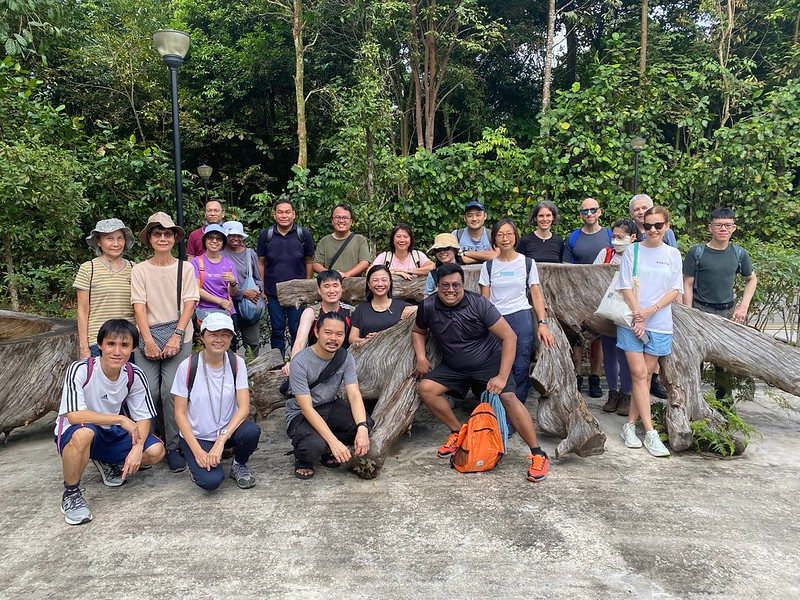
Over the years, people have given feedback that the Humanist Society (Singapore) struggles to scale up. Events are mostly small-group interactions, averaging about 15 to 30 attendees per event. While there are occasional bigger turnouts of 50-100 people, it usually happens only with collaborations with other groups, or comprise foreign delegates from abroad.
Indeed, while more than 20% of Singapore’s population identifies as having no religion, several cultural and structural factors keep the society’s physical turnouts small.
Cultural Context in Singapore
- No Urgent “Push” Factor. Unlike countries where secular organizations grow out of pushback against religious laws or discrimination, Singapore’s secular governance already protects non-religious people in daily life. Most non-religious Singaporeans feel little urgency to organize around their lack of faith.
- Lack of “Congregational” Habit. People who identify as non-religious or “freethinkers” in Singapore often do not feel a need for weekly communal gatherings or a church-like community structure.
- Privacy and Social Caution. Discussing religion, atheism, or leaving a faith remains a sensitive topic for many Singaporeans, especially when navigating relationships with religious family members. Many prefer engaging with the society’s content quietly online—where it has accumulated over 10,000 followers and hundreds of thousands of video views—rather than attending in person.
Volunteer Bandwidth
- All-Volunteer Operation. The society has no paid staff, meaning every meetup, panel, and newsletter is organized by committee members and volunteers balancing full-time jobs. Keeping physical events smaller and frequent (1 to 3 times a month) makes them sustainable without burning out organizers
Intentional Format and Venue Limits
- Venue Constraints. As a volunteer-run organization funded primarily by $20 annual membership fees, the group hosts events in cafes, nature trails, or small rented spaces like rooms at OnePeople.sg, which naturally restricts capacity.
- Deliberate Group Caps. Many of the society’s events are designed for intimate, open dialogue rather than large lectures. Sessions like Humanist Café or Death Café are explicitly capped at around 20 attendees to ensure everyone has space to speak.
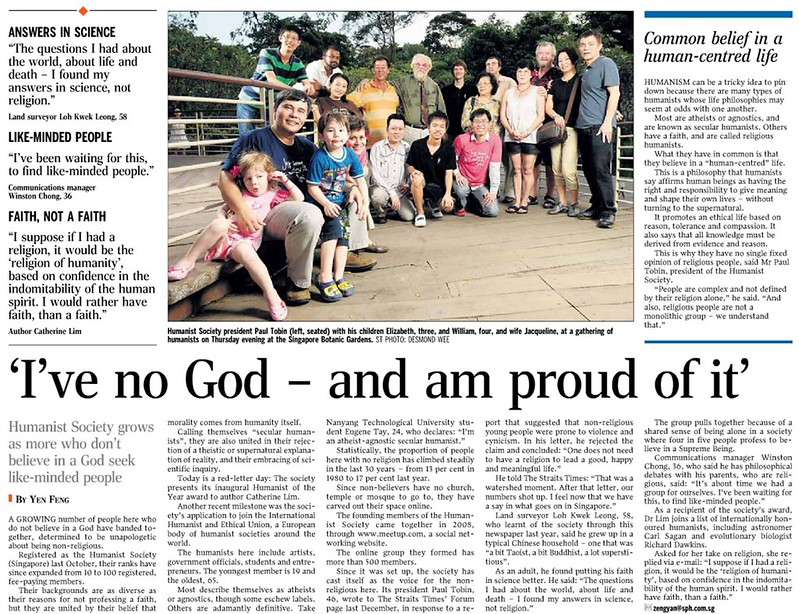
Photo above: A Straits Times feature of the Society in 2011.
So, has the Society failed?
Whether the Humanist Society (Singapore) has “failed” depends entirely on what metric you use to judge it.
If you measure success by mass mobilization and large crowd sizes, its physical footprint looks very small given that almost 1 in 4 Singaporean residents are non-religious. However, if you evaluate it against its actual constitutional goals, it is generally considered a stable, niche community group rather than a failure.
Why It Is Not Considered a Failure
- Consistent Execution of Its Core Mission: The society’s stated mission is to promote secularism, rational inquiry, and community among non-religious people in Singapore. By consistently running events, publishing educational materials, and maintaining its legal registration for over 16 years, it has fulfilled its basic mandate.
- Surviving Volunteer Burnout: In Singapore, many interest groups and small civil society organizations dissolve within two to three years when founding members move on. Remaining active, debt-free, and operational since 2010 is a sign of institutional resilience.
- Digital and Media Reach: Physical turnouts of 15–20 people do not reflect its wider footprint. Its online videos, articles, and social media channels reach tens of thousands of Singaporeans, and its representatives are occasionally consulted by local media or researchers regarding the non-religious demographic.
Where Critics Might See Limitations
- Limited Mass Appeal: Despite roughly one in five Singaporeans identifying as having no religion, the society has not become a household name or a mass movement. Most non-religious Singaporeans remain unaffiliated and uninterested in joining an organized humanist group.
- Niche Policy Influence: Because Singapore strictly regulates religious and political discourse to maintain social harmony, the society cannot engage in aggressive lobbying or confrontational activism. As a result, its direct influence on national policy remains modest compared to larger, established religious bodies.
Ultimately, the society operates more like a specialized interest club and support network than a mass political or social movement. For the core group of people seeking like-minded company, a non-religious voice for certain issues, and philosophical discussion, it serves its purpose well.