Archives for July 2026

Space for Spirituality in Secular Singapore? – Research Findings and Shared Reflections

***

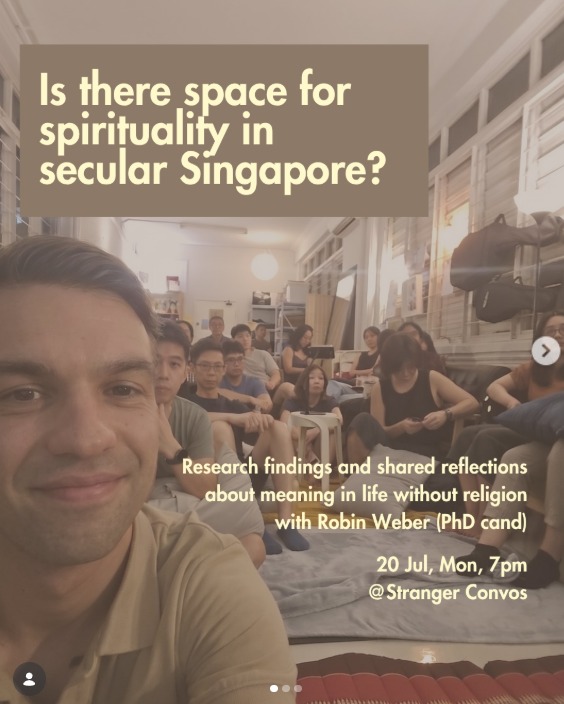
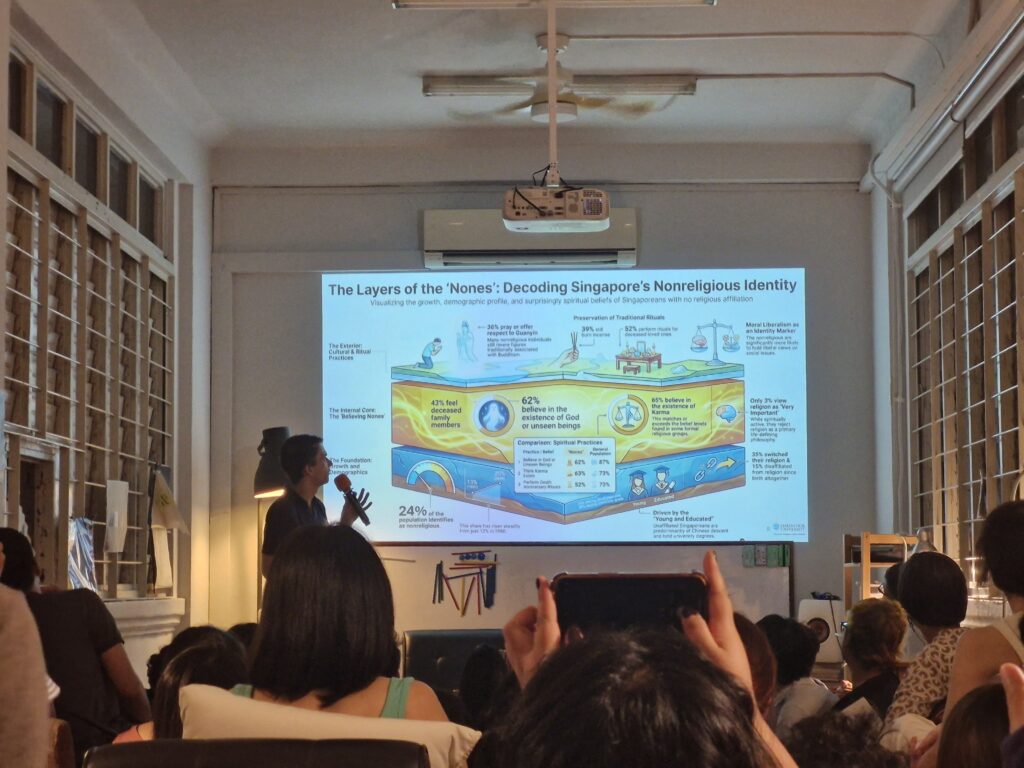
This gathering by Robin Weber, PhD Candidate and Psychological Researcher at James Cook University (Singapore Campus) was an open and collaborative exploration into non-religious spirituality in Singapore, examine the data and results of his ongoing doctoral research studying how spirituality is understood and practised in an increasingly secular society.

Spirituality is defined as “the personal quest for understanding answers to ultimate questions about life,” distinguishing it from organised religion. The study responds to a global increase in nonreligion but lack of research conducted in the Asia-Pacific region – where almost one-quarter of the world’s nonreligious population lives. This risks overlooking spiritual diversity, for example, compared with Europe, a much larger proportion of Singapore’s non-religious population identifies as “spiritual but not religious” (SBNR) and holds implicit spiritual beliefs.

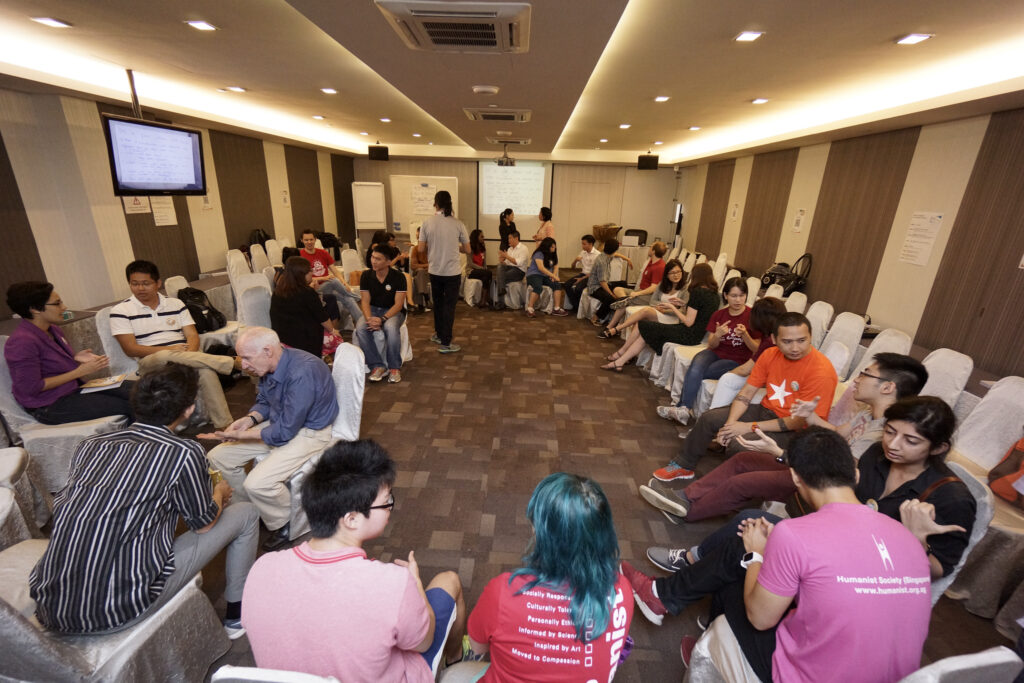
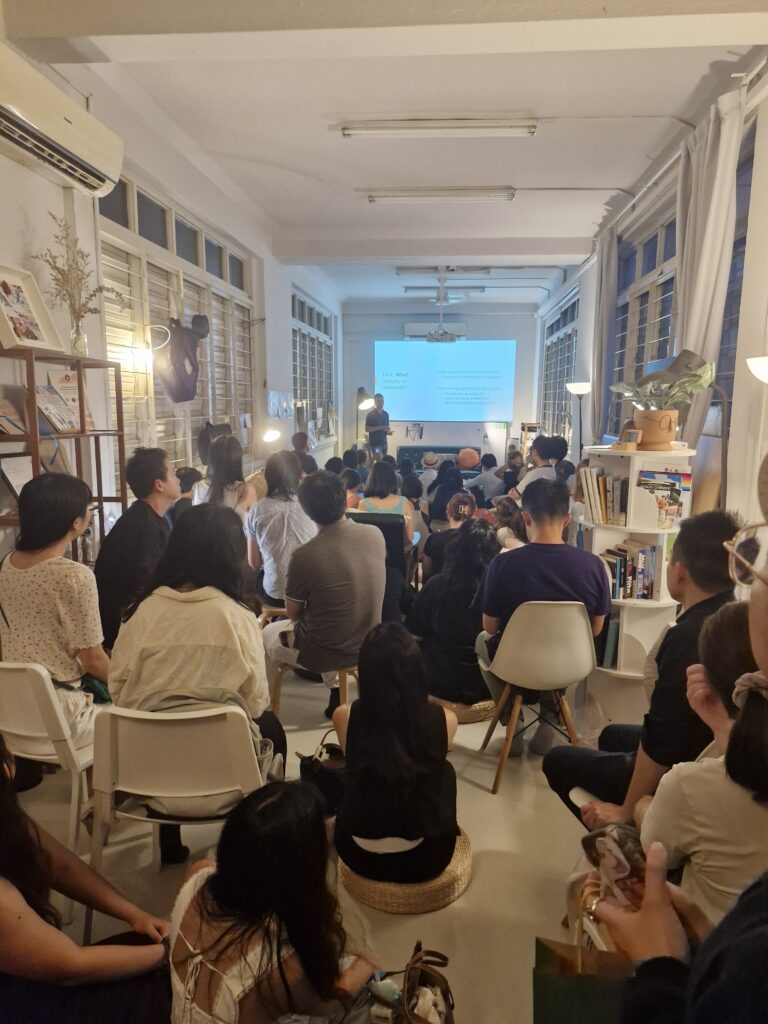
Photo below: Robin speaking to a large crowd.
***

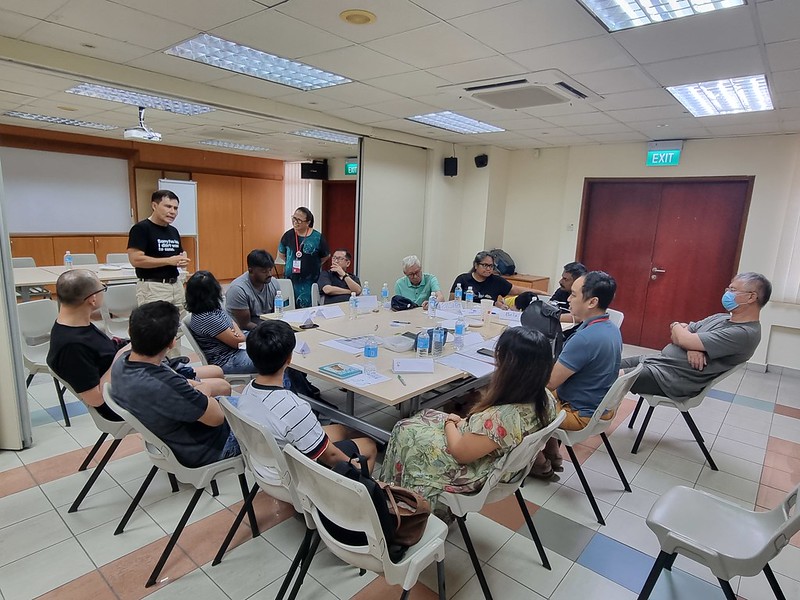
The presentation was centered on the speaker’s qualitative study in Singapore involving participants from diverse walks of life. After outlining the analysis’ six major themes, the room discussed each of them in groups to interpret, reflect and personally apply the implications of the findings. Guiding interview questions and excerpts from the interviews were shared with the groups to facilitate their conversations. Some of the topics participants talked about involved:

  • Connection with oneself, others, nature, and the wider world.
  • Belief in realities beyond the physical world, including higher powers, cosmic principles, an afterlife, etc.
  • Personalised spiritual practices that promote calmness and self-control.
  • Linking happiness with helping others, and community engagement.
  • Searching for meaning and purpose with spiritual guidance.
  • Freedom to choose one’s own path, emphasising autonomy, rationality, and individual agency.
***

An overarching finding is that identity underpins all six themes. Spirituality appears to be an important source of identity for many nonreligious people, yet Singapore’s blend of secularism is often perceived as an obstacle for spiritual expressions outside of religion. Robin reflected the interactions made him think whether dedicated spiritual spaces were desired to offer safe environments for people to explore otherwise often stigmatised beliefs. The presentation concluded with an  outlook on Robin’s future quantitative research.
Reflections on Singapore’s move towards non-religiosity

This is a commentary by the Executive Committee, Humanist Society (Singapore). The key driver of non-religiosity is diversity of information. However, misconceptions about non-religiosity persist and for some who left their faith, the social cost is real.

***

The latest General Household Survey 2025 showed that 23.9% of residents had no religious affiliation in 2025, up from 20% in 2020 and 18.5% in 2015.

This indicates an accelerating uptick in Singapore’s non-religious population, as 3.9% is more than double that of the previous 5 year intervals. Back in 1980, 13% were non-religious, showing that non-religiosity is not new. In fact, this demographic likely predates independence and has always been part of Singapore.

While there are many non-religious people/residents in Singapore from all walks of life, few organisations are dedicated to studying and building communities for the non-religious. The Humanist Society (Singapore) is one such organisation.

Over the years, we have engaged more than 7,000 non-religious individuals through our 300+ events, documenting many personal stories and perspectives. Based on this experience, we offer the following observations:

1) The key driver of non-religiosity is diversity of information

(Above) Asian Humanism Conference 2015, held in Singapore.

Some see non-religiosity as “another religion”, attributing its rise to active promotion. Others blame Westernisation, materialism, moral relativism, or even speculate about devil worship.

Our experience suggests otherwise. People leave religion—or remain non-religious—for many reasons. Some gradually find religious rituals less relevant. Others leave because certain teachings no longer align with their values.

One key factor in this shift is access to diversity of information. The internet exposes people to different religions, philosophies and worldviews. Humanity’s search for meaning is now accessible with a tap on the phone.

Increasingly, people evaluate beliefs critically instead of accepting them at face value. They build their principles from ideas they find most convincing, regardless of culture or religion. Over time, identifying with a particular religion becomes less meaningful, and many simply consider themselves non-religious.

2) Misconceptions about non-religiosity persist

For many, religion is the foundation of morality. This belief is often reinforced through lifelong teachings, while some religious texts portray non-believers negatively.

As a result, some continue to believe that non-religious people lack morality because, without God, nothing restrains immoral behaviour. They may even attribute crime, war and other social problems to godlessness, despite correlation not implying causation.

There is, however, no definitive evidence that being non-religious or atheist makes a person immoral. Multiple studies show that countries with high proportions of non-religious people also perform well on measures such as low crime, prosperity, equality, freedom, democracy, women’s rights, human rights, education and life expectancy. Examples include Sweden, Denmark, Norway, the Czech Republic, Estonia, Uruguay, Japan, Britain, France, the Netherlands, Germany, South Korea, New Zealand and Australia.

This is not to suggest that non-religiosity itself reduces crime. Strong education, effective law enforcement and many other factors also play essential roles. This is something that Singapore as a secular state has achieved since independence because of our strong rule of law and efforts to foster social cohesion. 

3) For some who left their faith, the social cost is real  

From our engagement with the non-religious, those from highly devout or conservative families often face strong opposition after leaving their faith, frequently because of the misconceptions described above in 2).

For those who left their faith, even if they remain kind and well-intentioned, their decision may be seen as rejecting their family’s or community’s identity. In some cases, these relationships never recover.

It is therefore important for those who left their faith, especially those who become non-religious, to have social support networks such as the Humanist Society. It is equally important that their experiences are acknowledged and represented, including in interfaith dialogue. Their pain should not be ignored out of fear of offending others.

(Above) One of the numerous support sessions organised by the Humanist Society (Singapore).

4) Most non-religious people genuinely do not believe in God or consider themselves spiritual

A common response to the growing non-religious population is that they are “still religious”, “culturally religious”, “spiritual”, or simply “temporarily lost”. We sometimes get the sense that people wish to keep them within their religious fold.

While some non-religious people continue to hold supernatural, theistic or spiritual beliefs, our experience is that most do not.

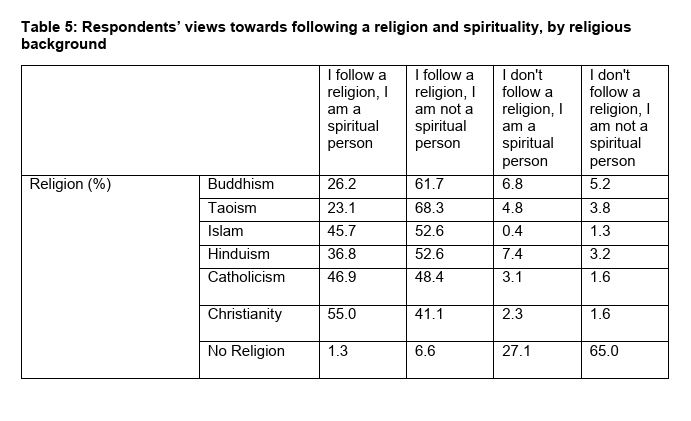
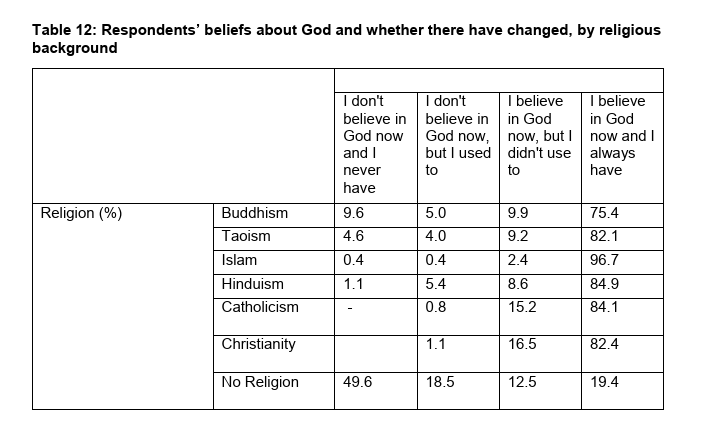
This is supported by this Institute of Policy Studies (IPS) working paper, which found that among non-religious respondents, 65% neither followed a religion nor considered themselves spiritual, while 68.1% did not believe in God.

Source: Pg 28, IPS Working Papers No.33, “Religion in Singapore: The Private and Public Spheres”, published in 2019.

Source: Pg 34, IPS Working Papers No.33, “Religion in Singapore: The Private and Public Spheres”, published in 2019. 

5) The non-religious contribute positively to interfaith dialogue and religious harmony

The Humanist Society (Singapore) supports and has taken part in interfaith dialogues to strengthen understanding among religious communities as well as between religious and non-religious people. We support Singapore’s model of secularism, which provides space for diverse belief systems while ensuring public policy benefits all Singaporeans regardless of race or religion.

Our longstanding positions include:

  • Disagreements over beliefs should be resolved through dialogue rather than police reports or legal action.
  • Every individual has the right to hold and express their beliefs. At the same time, no belief should be beyond scrutiny or discussion. In the pursuit of truth and a better world, all ideas should be examined for logical soundness and tested against the best available evidence.

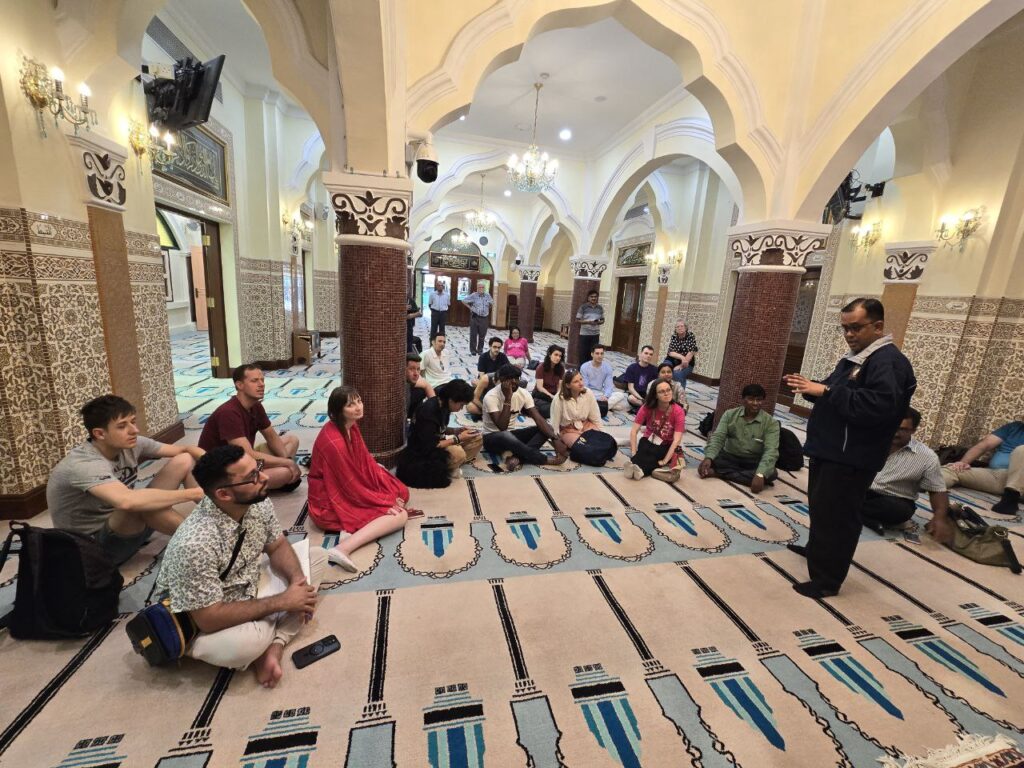
(Above) An interfaith visit to a mosque, organised by the Humanist Society (Singapore) in 2024.

Concluding thoughts 

Freedom from religion should also be part of freedom of religion.

Sadly, being non-religious, particularly atheist, is illegal or dangerous in many countries. The fact that 23.9% of Singapore residents can openly identify as non-religious reflects Singapore’s success in building a forward-looking, multiracial and multireligious society. Freedom from religion is something to be proud of, not feared or viewed with disdain. 

The Humanist Society (Singapore) will continue to monitor developments in this area and serve as a voice and refuge for the non-religious.