Lawyers, Humanists and the Religious Walk Into a Bar…
Day One — A Quranic Perspective, Challenging Common Misconceptions that Islam Restricts Personal Freedom in Matters of Faith
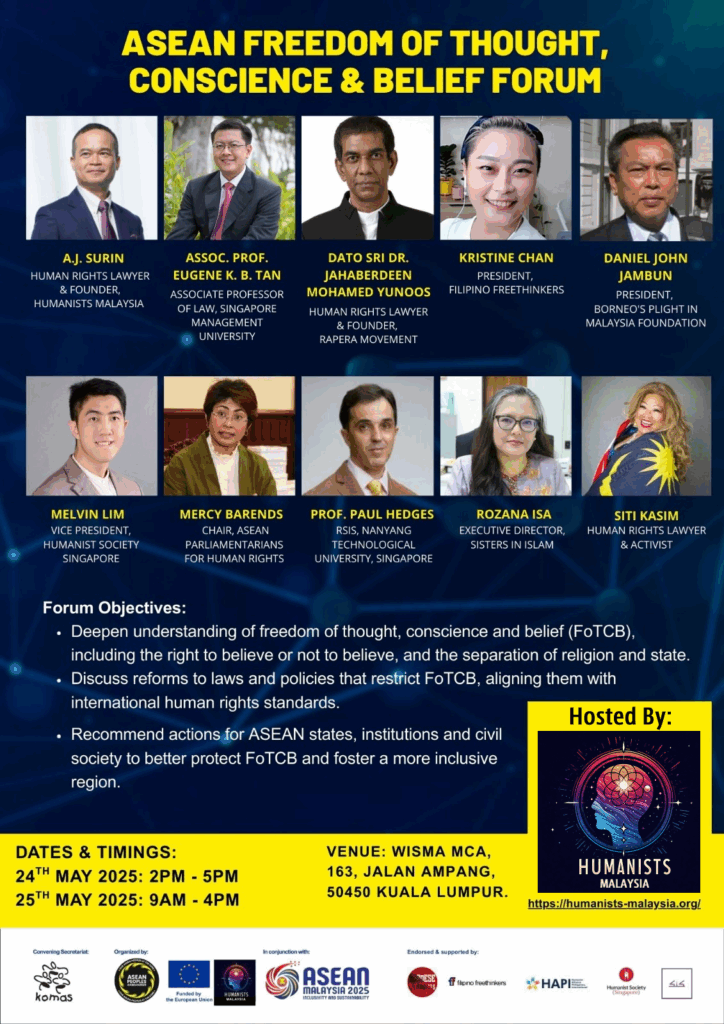
Day one kicked off with Panelist Dr Jahaberdeen M. Yunoos, with his lecture purporting that Islam as a faith could be practiced and applied in a manner that preserves personal liberties, and allows for questioning and skepticism. Directly confronting the notion that Islam as a faith or ideology on its own advocates conformity and control, Dr Jahaberdeen proposes textual critique of the religious text that suggests an alternate interpretation that champions individual accountability, and he further asserts that civil dialogue is not only encouraged, but commanded, with disagreements handled ethically. Ending his segment with a Quranic Call to Freedom, he calls upon his Muslim fellows to reclaim the liberating spirit of the Quran.
Within the Question & Answer (Q&A) Segment, Dr Jahaberdeen addresses his views on the Quran only movement in swing within Malaysia. He expresses that he is happy that this notion is prompting Muslims to take a closer look at the fundamental text, explaining that quite a bit of Islamic practices are derived from Hadiths and scholarly interpretations.
For several of the questions addressing the nature of religious conflicts and fatwas (religious laws) being enforced legally in Malaysia, he connects the dots to the history of politics in these ideologies, and he implores his peers to free themselves from politicians and clergy, concluding with the quip, “God didn’t give us brain for decoration”.
Finally, he admits that reform takes a long time, but he is hopeful, as more and more of his peers are questioning dogma, and adopting independently derived views and stances in accordance to their own sense of reason and morality.
Credits: Mr Sree, for taking the full video of Mr Jahaberdeen’s speech.
Day One — Interfaith Dialogue: Combating Religious Extremism and Discrimination Through Dialogue
Dr Hedges presented and shared that drawing from the Singapore experience and perspective, policies involving “contact” were critical. The concept is simple – when people of different beliefs come together, there is opportunity for interaction, exchange of views and better understanding of each others’ perspectives and beliefs. In fact, interacting with people of diverse beliefs leads to humility, where one realizes and understands that other different positions and views exists (in contrast to interacting with just people of the same belief which results in an echo chamber). Dr Hedges also shared that in his view, Singapore’s Ethnic Integration Policy (EIP) was the most successful policy enacted that allowed Singapore to avoid the kind of religious extremism, discrimination and radicalization we see in many parts of the world. The EIP intervened at a very personal level, but played a crucial role in preventing the creation of ghettos and the natural tendency for humans to mingle only with those of their same stripe.
Dr Hedges further shared that there were also open and closed doors interfaith dialogues, where people from different faiths/religion come together to meet and interact, such as IRO or IRCC.
Responding to an audience question during his Q&A segment on whether there were any examples of humanists in other parts of the world that worked closely with the government, Dr Hedges replied that he was not aware of any such examples. A member of the audience also shared that in Malaysia, while there exists an IRO equivalent, the board does not have Muslims on board, which begs the question as to whether Muslims should even be involved or be part of the panel. The answer from Dr Hedges was a resounding yes. He felt that the board should be as inclusive as possible, and that it would be remiss to not have a representative from the dominant religion be part of the board or conversations to get the lay of the land.
Credits: Mr Eugene Tay for attending this talk and contributing this write up on Day One.
Day One — The International Human Rights Framework on Freedom of Religion, Belief and Education
Attending the Conference via Zoom from Europe, Mr Leon Langdon introduced himself as the advocacy officer for Humanists International (HI). He supports HI’s work at the United Nations Human Rights Council, as well as HI’s broader advocacy efforts. He shared that generally, work at HI was varied and that no two days were the same. For HI’s broader advocacy work, he revealed that HI takes a deliberate stance by talking about various issues with low coverage – two specific examples being Female Genital Mutilation (FGM) and Witchcraft. As advocacy officer, he also highlights and writes on these issues to raise awareness. HI’s work is also heavily centered around ensuring that people have freedom of religion; and freedom of education. While these may seem to be basic and fundamental rights, Leon shared that this was still not possible in present day in many countries around the world.
Credits: Mr Eugene Tay for attending this talk and contributing this write up on Day One.
Day One — Post Event
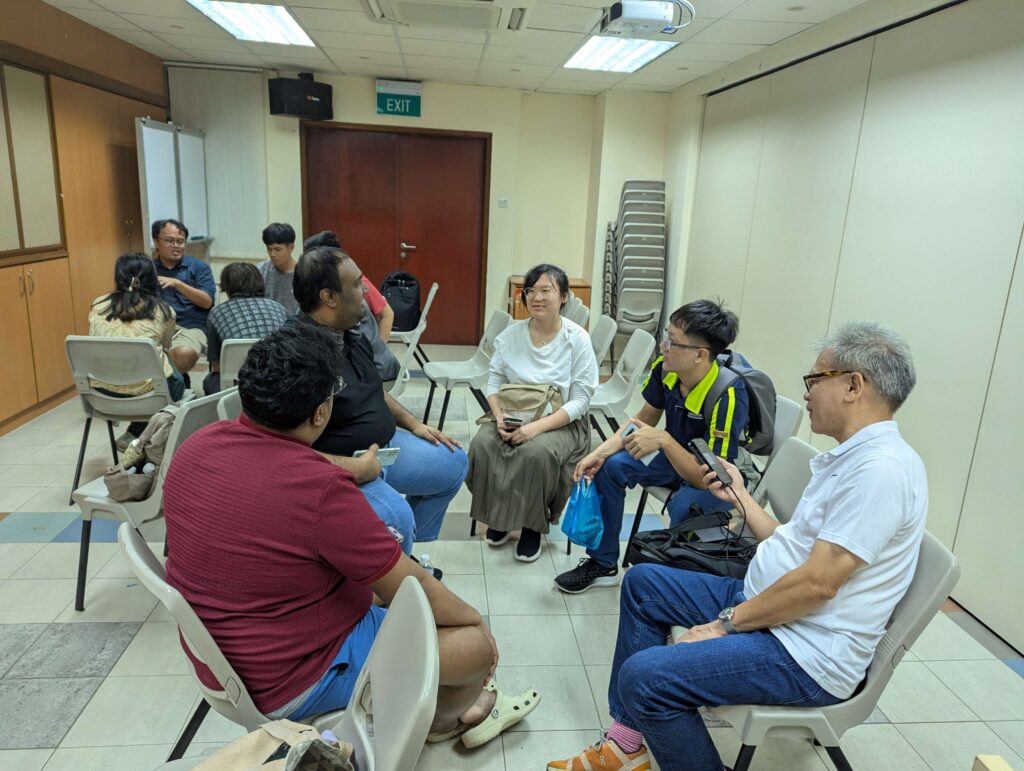
The Humanists Society (Singapore)’s Honorary Auditor, Mr Sreekanth, was invited for an interview with Humanists Malaysia. Do look forward to when it is released!
The wheels on the bus go round and round for five hours…
Day Two — “Is our democracy still a guardian of inclusive harmony, or is it becoming increasingly susceptible to exclusivist interpretations of identity and faith?”
An impassioned speech with fire and steel sparked Day Two off, with Speaker Rozana Iza illuminating the plight and situation of the legal landscape in Malaysia, wherein the Mufti Bill, tabled in 2023, was passed without public consultation — posing a threat to democracy by provisioning religious authorities with dubious reaches of administration by way of allowing them to grant “Aqidah consultants” the right to question and counsel marked individuals on their beliefs. This state-enforced infringement of personal freedoms for the sake of Sharia compliance was the subject of gravitas, and led to the next point.
Addressing Womens’ Rights in Malaysia in the present day, Ms Rozana sheds light on how the current practices of Islamic legislative enforcement of fatwas and extreme conservatism have lead to the ambitions and dreams of aspiring young women being affected by a system that uses and disposes of them at opaque discretion. As Executive Director of Sisters in Islam (SIS), Ms Rozana expresses that she takes pride in her faith, asserting that it is meant to stand for equality and justice, and no clergy asserting punitive action on fatwas should use it to oppress women and personal liberties.
A case study of these policies in action is how the state of Terengganu has enforced Sharia Law even in schools, denying girls their ambitions and passions in arts such as gymnastics and diving, and further imposing on them the ultimatum of transferring to other arts such as Wushu or ceasing their athletic career entirely, under the veneer of a concession.
Emphasizing the personal nature of faith, Ms Rozana maintains the position that as long as life is lived in a fashion that upholds good and personal morality, nobody’s life decisions should be judged by man, but only by one’s personal connection to their religion.
Day Two — A Brief Introduction of Humanism by Humanists Malaysia
President of Humanists Malaysia, Mr AJ Surin followed up, providing a concise introduction of humanism as interpreted by Humanists International and the Amsterdam declaration as a baseline. Expounding on how Humanists and atheists in Malaysia lay low by not even registering themselves as an official Society, he does express optimism, sharing that the movement is growing gradually.
In collaboration, the President of Humanist Society (Singapore) was invited to also illuminate the differences between the natures of Humanists Malaysia and Humanists Singapore, revealing how topics of discussion and the natures of discourse differ between the two cultures, due to the differences in priority.
Humanists Malaysia has a heavier role as a clandestine political agent against a climate hostile to atheism and secularism, while Humanists Singapore, in contrast, discusses how better to be a prominent space for the non-religious to find meaningful community.
Day Two — Decolonizing Belief: The Struggle for Freedom of Thought & Indigenous Identity in Post-Colonial Southeast Asia
Dr Daniel John Jambun concluded the morning session by addressing the plight of the people in Borneo, an island in a unique position as it is shared by three countries: Indonesia, Malaysia, and Brunei. Presenting news articles on how his people are covertly converted to Islam on their official documents, he read an earnest letter, calling on other ASEAN countries to acknowledge this matter, and for reforms to be made to put a stop to such malpractices.
Illustrating the highlighted phenomenon, is the current situation in Sabah wherein indigenous cultures and belief systems in the native locale have been systematically eroded by powers both colonial and post-colonial, which has led to the loss of right, dignity and autonomy for the natives there. The region of Sabah faces unique issues caused by migration policies that have shifted demographics, carrying the baggage of stricter interpretations and doctrines of Islam that has limited freedom of thought and belief, amidst a landscape already littered with conversion without consent and deceit.
As a proposed solution, Dr Daniel advocates for a regional framework inspired by models such as the Rabat Plan of Action to protect indigenous beliefs, prohibit deceptive conversions, ensure representation for minorities, and uphold the right to disbelief. Storytelling and community-level dialogues are emphasized as tools for change.
Day Two — Morning Session Q&A
Of particular note was a question posed to the panelists — what was the extent of impact should the field for religion on one’s documentation be altered?
Ms Rozana answered this query with sharp clarity, exemplifying how this seemingly simple change can and would subject unsuspecting individuals to an entirely new set of laws and regulations that would not have been anything they would have consented to. She brought up a case study of how a woman, converting to Islam for marriage, found no solace, assistance nor refuge in the Sharia courts, nor her Islamic fellows, nor Muslim communities, when her family situation took a turn for the worse after the conversion. Even though Muslim communities then proceeded to pay her mind — after her misgivings went viral on social media — no one should be subject to such changes to their lives without informed consent.
Day Two — Religion and the State: Finding the
Balance
Drawing from her experience and cases as a Human Rights Lawyer, Ms Kasim has tackled a number of cases wherein an individual wishes to deconvert from Islam, but due to the political and legal powers that be within the vicinity, such cases typically end in disappointment. Ms Kasim shares that many who convert to Islam typically have a lower level of education, and their decisions to convert in the first place could have incentives involved, such as monetary gain or gifts to sweeten the pot, while the officials overseeing the conversion process downplay the severity of the decision the individual is being influenced to make.
A case was presented as an example, where a woman was converted as a child but raised Hindu, and consequently, was tragically unable to leave Islam for marriage.
To illustrate the stark contrasts in religious political landscapes, Ms Kasim brought up other countries for comparison. Comparable to Malaysia’s Islamic political landscape, Brunei continues to uphold a monarchy where the Sultan is the religious leader, and Sharia law extends to all citizens, Muslim and non-Muslim.
While Indonesia is adjacent to Malaysia in terms of Islamic cultural and national identity, state-driven Islamization is less pronounced than in Malaysia, even though Islamic parties and leaders still do influence politics. In contrast to Malaysia that now has a 54% public support for religious in office, recent trends show a decline in Indonesia’s political Islam’s influence compared to the former’s rising conservatism.
For other countries such as Thailand and Cambodia, Buddhism and national identity are also closely linked, but has less political influence. The Philippines is predominantly Catholic with some church influence on social issues, but has no official state religion.
The rest of the SEA countries such as Singapore, Vietnam, Laos and Myanmar are either secular or have a religious majority of other faiths, but religion has minimal influence on policy and politics.
Given the above, Malaysia is distinct for its deep integration of political Islam and race-based politics, driven by government-led Islamization and public support, setting it apart in ASEAN. Furthermore, despite calls to action and pleas for help, ASEAN’s principle of non-interference limits its ability to address issues like religious extremism or minority oppression in member states like Malaysia and minority faiths (e.g., Ahmadiyya, Shia) and individuals facing religious repression (e.g., inability to leave Islam) lack recourse within ASEAN due to this policy.
Day Two — The Gambits of Morality; Objective
Decisions for a World in Flux (“What happens when we do not agree on what is right?”)
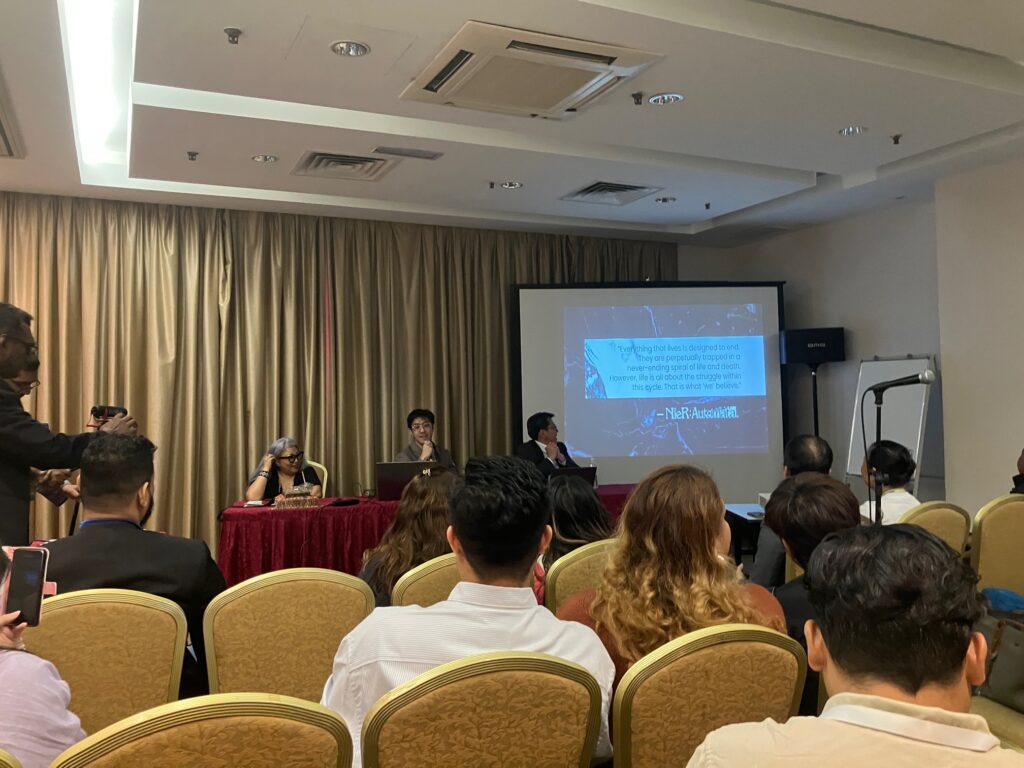
President of the Humanist Society (Singapore) Melvin delivered a lecture on how morals can be developed purely through reason and long term investment into human wellbeing as an objective metric. Likening morality to a chess match — wherein the goal is driven by self-interest, and even when putting aside ambiguous language such as ‘compassion’ and ‘kindness’ — Melvin explains how even the most selfish reasons and base instincts of survival can lead to cooperative behavior.
Presenting scientific articles and research on animals to illustrate how compassionate behavior can arise as an emergent property of social groups, Melvin extrapolates the underlying reasons to such findings to the real world, using various ASEAN countries and significant events in history as case studies to illustrate how Humanistic principles and methods primarily utilizing reason have lead to tangible progress in the aspects of economics and healthcare.
Finally, continuing to use chess as an analogy, Melvin finally illustrates how the landscape of morality is littered with sacrifices and gambits, and it is through disagreeing with the ‘correct’ moves to make that fuels discourse regarding morality. Much like how chess is a game that has not been solved, neither has the problem of morality. However, Melvin asserts that instead of succumbing to resignation in the face of no perfect answer, the only way to work toward better decisions is to continue learning, encourage constructive discourse, and to refuse complacency.
Through this speech and some audience participation activities, it elucidated the subtle and nuanced differences between the ways people thought, and also the differences between how Humanists Singapore and Humanists Malaysia tackled such discourse.
A full article and a speech on this topic may be written or delivered to the Society at a later date. That said, who could have ever imaged that quotes from games such as Nier Automata would have made it to a slide for an ASEAN conference on Freedom of Thought and Conscience?
Day Two — Religious freedom in
Singapore and repeal of section 377A of the Penal Code
To preserve Professor Eugene Tan’s ideas and to reduce information dilution, here are articles offering his views, written and spoken by his esteemed self. Here is his written OpEd regarding the Repeal of S377A, and here is a segment where he spoke on Channel News Asia. Do give him a read and listen.
Closing Remarks
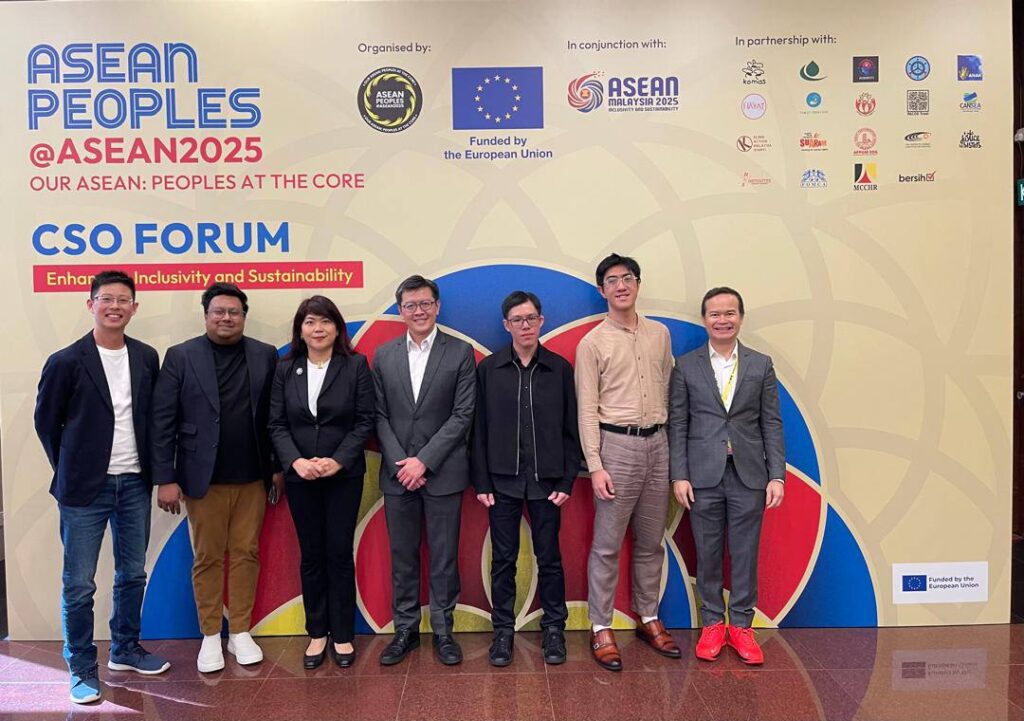
This report was written with the intent of presenting all speakers’ points and speeches as objectively as possible, while uplifting and extolling the valuable depth and breadth of information and ideas they have contributed in the spirit of edification and elucidation. While some points might not be fully agreed upon, it is undeniable that this Conference has revealed the landscape of different beliefs even within similar belief systems, with varying ideas of belief, faith and perspectives on liberty and freedom of thought.
A critiqued—opinion editorial or discussion in a form yet to be confirmed will be arranged at a later date, examining a few key points raised by various speakers through a humanistic and skeptical lens, for the betterment of discourse within the HSS community.
Special Thanks
Honorary Auditor Sreekanth Vasudevakurup for attending Day One and doing an interview with Humanists Malaysia.
Member Eugene Tay for attending Day One and Two, assisting with the write-ups of Day One, and offering pertinent advice to the EXCO on Day Two.
EXCO Member Lava, for being tour guide, planning transport, meals and various fiscal miscellany. He also kept and provided a few transcripts of the speeches from Day Two, which were used to assist in this write-up.
Assistant Secretary Ong Yew Hwee for offering valuable insight and taking notes which informed certain nuances.
The President’s wife, Ms Glena Chan, for being a moral support and camera-lady.