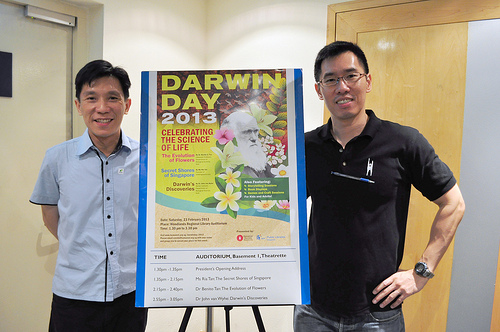
ASEAN Freedom of Thought, Conscience & Belief Forum 2025 — Key Insights & Takeaways

Lawyers, Humanists and the Religious Walk Into a Bar…
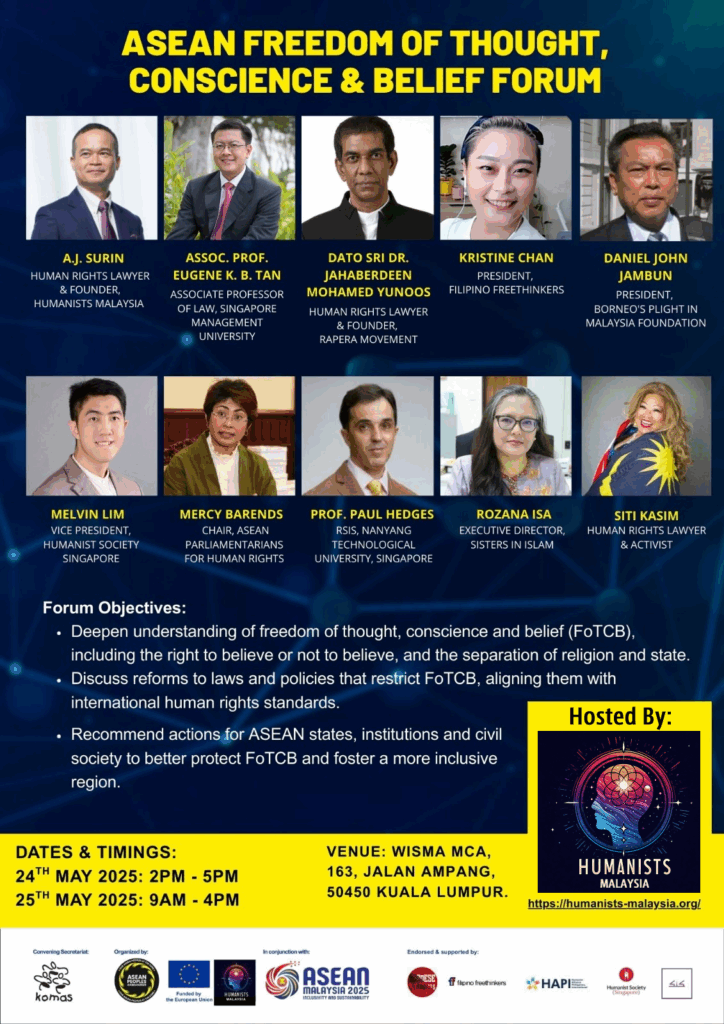
Day One — A Quranic Perspective, Challenging Common Misconceptions that Islam Restricts Personal Freedom in Matters of Faith

Day one kicked off with Panelist Dr Jahaberdeen M. Yunoos, with his lecture purporting that Islam as a faith could be practiced and applied in a manner that preserves personal liberties, and allows for questioning and skepticism. Directly confronting the notion that Islam as a faith or ideology on its own advocates conformity and control, Dr Jahaberdeen proposes textual critique of the religious text that suggests an alternate interpretation that champions individual accountability, and he further asserts that civil dialogue is not only encouraged, but commanded, with disagreements handled ethically. Ending his segment with a Quranic Call to Freedom, he calls upon his Muslim fellows to reclaim the liberating spirit of the Quran.

Within the Question & Answer (Q&A) Segment, Dr Jahaberdeen addresses his views on the Quran only movement in swing within Malaysia. He expresses that he is happy that this notion is prompting Muslims to take a closer look at the fundamental text, explaining that quite a bit of Islamic practices are derived from Hadiths and scholarly interpretations.

For several of the questions addressing the nature of religious conflicts and fatwas (religious laws) being enforced legally in Malaysia, he connects the dots to the history of politics in these ideologies, and he implores his peers to free themselves from politicians and clergy, concluding with the quip, “God didn’t give us brain for decoration”.

Finally, he admits that reform takes a long time, but he is hopeful, as more and more of his peers are questioning dogma, and adopting independently derived views and stances in accordance to their own sense of reason and morality.

Credits: Mr Sree, for taking the full video of Mr Jahaberdeen’s speech.

Day One — Interfaith Dialogue: Combating Religious Extremism and Discrimination Through Dialogue

Dr Hedges presented and shared that drawing from the Singapore experience and perspective, policies involving “contact” were critical. The concept is simple – when people of different beliefs come together, there is opportunity for interaction, exchange of views and better understanding of each others’ perspectives and beliefs. In fact, interacting with people of diverse beliefs leads to humility, where one realizes and understands that other different positions and views exists (in contrast to interacting with just people of the same belief which results in an echo chamber).  Dr Hedges also shared that in his view, Singapore’s Ethnic Integration Policy (EIP) was the most successful policy enacted that allowed Singapore to avoid the kind of religious extremism, discrimination and radicalization we see in many parts of the world. The EIP intervened at a very personal level, but played a crucial role in preventing the creation of ghettos and the natural tendency for humans to mingle only with those of their same stripe. 

Dr Hedges further shared that there were also open and closed doors interfaith dialogues, where people from different faiths/religion come together to meet and interact, such as IRO or IRCC. 

Responding to an audience question during his Q&A segment on whether there were any examples of humanists in other parts of the world that worked closely with the government, Dr Hedges replied that he was not aware of any such examples. A member of the audience also shared that in Malaysia, while there exists an IRO equivalent, the board does not have Muslims on board, which begs the question as to whether Muslims should even be involved or be part of the panel.  The answer from Dr Hedges was a resounding yes. He felt that the board should be as inclusive as possible, and that it would be remiss to not have a representative from the dominant religion be part of the board or conversations to get the lay of the land. 

Credits: Mr Eugene Tay for attending this talk and contributing this write up on Day One.

Day One — The International Human Rights Framework on Freedom of Religion, Belief and Education

Attending the Conference via Zoom from Europe, Mr Leon Langdon introduced himself as the advocacy officer for Humanists International (HI). He supports HI’s work at the United Nations Human Rights Council, as well as HI’s broader advocacy efforts. He shared that generally, work at HI was varied and that no two days were the same. For HI’s broader advocacy work, he revealed that HI takes a deliberate stance by talking about various issues with low coverage – two specific examples being Female Genital Mutilation (FGM) and Witchcraft. As advocacy officer, he also highlights and writes on these issues to raise awareness. HI’s work is also heavily centered around ensuring that people have freedom of religion; and freedom of education. While these may seem to be basic and fundamental rights, Leon shared that this was still not possible in present day in many countries around the world.

Credits: Mr Eugene Tay for attending this talk and contributing this write up on Day One.

Day One — Post Event

The Humanists Society (Singapore)’s Honorary Auditor, Mr Sreekanth, was invited for an interview with Humanists Malaysia. Do look forward to when it is released!
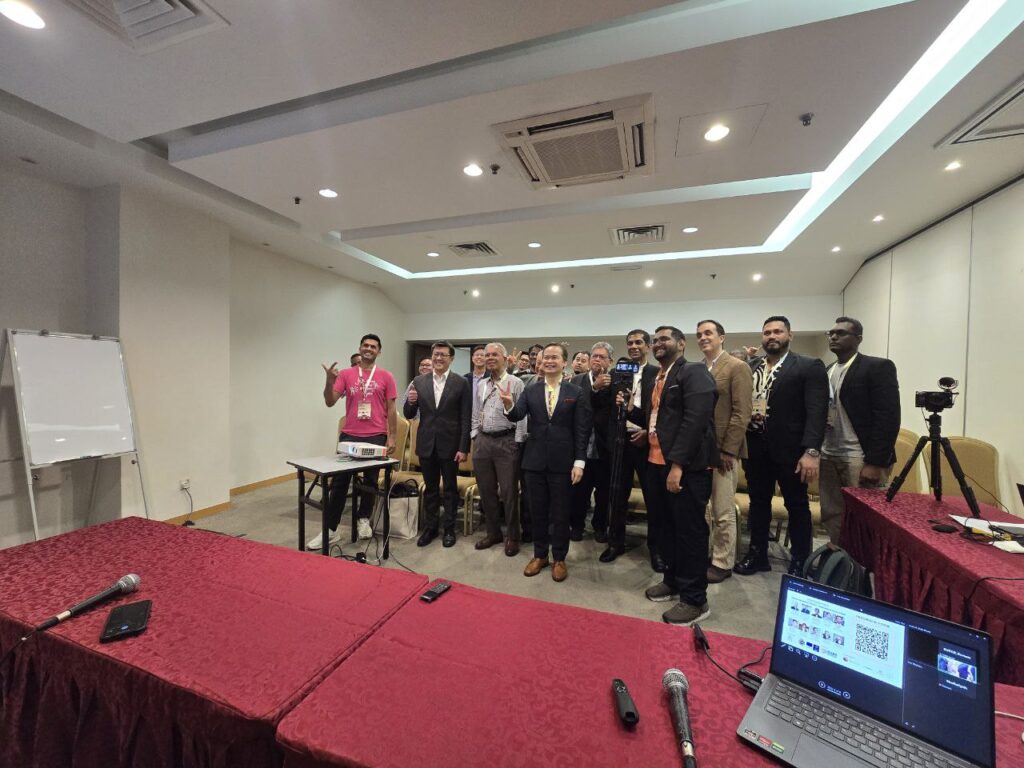
The wheels on the bus go round and round for five hours…
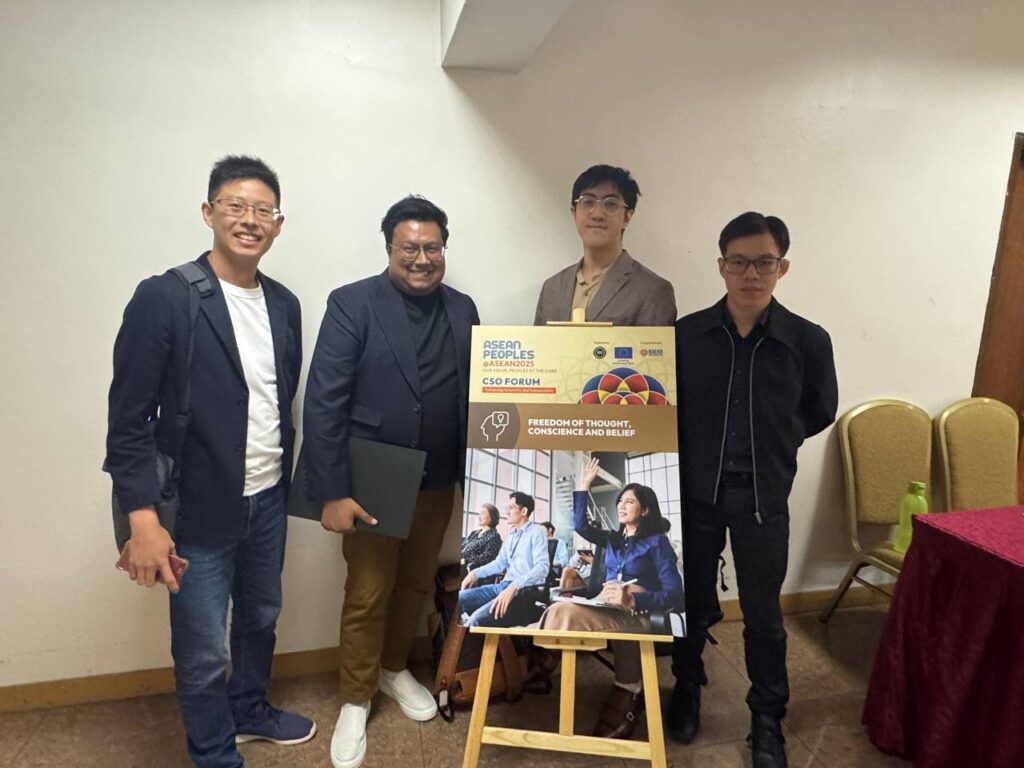
Day Two — “Is our democracy still a guardian of inclusive harmony, or is it becoming increasingly susceptible to exclusivist interpretations of identity and faith?”

An impassioned speech with fire and steel sparked Day Two off, with Speaker Rozana Iza illuminating the plight and situation of the legal landscape in Malaysia, wherein the Mufti Bill, tabled in 2023, was passed without public consultation — posing a threat to democracy by provisioning religious authorities with dubious reaches of administration by way of allowing them to grant “Aqidah consultants” the right to question and counsel marked individuals on their beliefs. This state-enforced infringement of personal freedoms for the sake of Sharia compliance was the subject of gravitas, and led to the next point.

Addressing Womens’ Rights in Malaysia in the present day, Ms Rozana sheds light on how the current practices of Islamic legislative enforcement of fatwas and extreme conservatism have lead to the ambitions and dreams of aspiring young women being affected by a system that uses and disposes of them at opaque discretion. As Executive Director of Sisters in Islam (SIS), Ms Rozana expresses that she takes pride in her faith, asserting that it is meant to stand for equality and justice, and no clergy asserting punitive action on fatwas should use it to oppress women and personal liberties.

A case study of these policies in action is how the state of Terengganu has enforced Sharia Law even in schools, denying girls their ambitions and passions in arts such as gymnastics and diving, and further imposing on them the ultimatum of transferring to other arts such as Wushu or ceasing their athletic career entirely, under the veneer of a concession.

Emphasizing the personal nature of faith, Ms Rozana maintains the position that as long as life is lived in a fashion that upholds good and personal morality, nobody’s life decisions should be judged by man, but only by one’s personal connection to their religion.

Day Two — A Brief Introduction of Humanism by Humanists Malaysia

President of Humanists Malaysia, Mr AJ Surin followed up, providing a concise introduction of humanism as interpreted by Humanists International and the Amsterdam declaration as a baseline. Expounding on how Humanists and atheists in Malaysia lay low by not even registering themselves as an official Society, he does express optimism, sharing that the movement is growing gradually.

In collaboration, the President of Humanist Society (Singapore) was invited to also illuminate the differences between the natures of Humanists Malaysia and Humanists Singapore, revealing how topics of discussion and the natures of discourse differ between the two cultures, due to the differences in priority.

Humanists Malaysia has a heavier role as a clandestine political agent against a climate hostile to atheism and secularism, while Humanists Singapore, in contrast, discusses how better to be a prominent space for the non-religious to find meaningful community.

Day Two — Decolonizing Belief: The Struggle for Freedom of Thought & Indigenous Identity in Post-Colonial Southeast Asia

Dr Daniel John Jambun concluded the morning session by addressing the plight of the people in Borneo, an island in a unique position as it is shared by three countries: Indonesia, Malaysia, and Brunei. Presenting news articles on how his people are covertly converted to Islam on their official documents, he read an earnest letter, calling on other ASEAN countries to acknowledge this matter, and for reforms to be made to put a stop to such malpractices.

Illustrating the highlighted phenomenon, is the current situation in Sabah wherein indigenous cultures and belief systems in the native locale have been systematically eroded by powers both colonial and post-colonial, which has led to the loss of right, dignity and autonomy for the natives there. The region of Sabah faces unique issues caused by migration policies that have shifted demographics, carrying the baggage of stricter interpretations and doctrines of Islam that has limited freedom of thought and belief, amidst a landscape already littered with conversion without consent and deceit.

As a proposed solution, Dr Daniel advocates for a regional framework inspired by models such as the Rabat Plan of Action to protect indigenous beliefs, prohibit deceptive conversions, ensure representation for minorities, and uphold the right to disbelief. Storytelling and community-level dialogues are emphasized as tools for change.

Day Two — Morning Session Q&A

Of particular note was a question posed to the panelists — what was the extent of impact should the field for religion on one’s documentation be altered?

Ms Rozana answered this query with sharp clarity, exemplifying how this seemingly simple change can and would subject unsuspecting individuals to an entirely new set of laws and regulations that would not have been anything they would have consented to. She brought up a case study of how a woman, converting to Islam for marriage, found no solace, assistance nor refuge in the Sharia courts, nor her Islamic fellows, nor Muslim communities, when her family situation took a turn for the worse after the conversion. Even though Muslim communities then proceeded to pay her mind — after her misgivings went viral on social media — no one should be subject to such changes to their lives without informed consent.

Day Two — Religion and the State: Finding the
Balance

Drawing from her experience and cases as a Human Rights Lawyer, Ms Kasim has tackled a number of cases wherein an individual wishes to deconvert from Islam, but due to the political and legal powers that be within the vicinity, such cases typically end in disappointment. Ms Kasim shares that many who convert to Islam typically have a lower level of education, and their decisions to convert in the first place could have incentives involved, such as monetary gain or gifts to sweeten the pot, while the officials overseeing the conversion process downplay the severity of the decision the individual is being influenced to make.

A case was presented as an example, where a woman was converted as a child but raised Hindu, and consequently, was tragically unable to leave Islam for marriage.

To illustrate the stark contrasts in religious political landscapes, Ms Kasim brought up other countries for comparison. Comparable to Malaysia’s Islamic political landscape, Brunei continues to uphold a monarchy where the Sultan is the religious leader, and Sharia law extends to all citizens, Muslim and non-Muslim.

While Indonesia is adjacent to Malaysia in terms of Islamic cultural and national identity, state-driven Islamization is less pronounced than in Malaysia, even though Islamic parties and leaders still do influence politics. In contrast to Malaysia that now has a 54% public support for religious in office, recent trends show a decline in Indonesia’s political Islam’s influence compared to the former’s rising conservatism.

For other countries such as Thailand and Cambodia, Buddhism and national identity are also closely linked, but has less political influence. The Philippines is predominantly Catholic with some church influence on social issues, but has no official state religion.

The rest of the SEA countries such as Singapore, Vietnam, Laos and Myanmar are either secular or have a religious majority of other faiths, but religion has minimal influence on policy and politics.

Given the above, Malaysia is distinct for its deep integration of political Islam and race-based politics, driven by government-led Islamization and public support, setting it apart in ASEAN. Furthermore, despite calls to action and pleas for help, ASEAN’s principle of non-interference limits its ability to address issues like religious extremism or minority oppression in member states like Malaysia and minority faiths (e.g., Ahmadiyya, Shia) and individuals facing religious repression (e.g., inability to leave Islam) lack recourse within ASEAN due to this policy.

Day Two — The Gambits of Morality; Objective
Decisions for a World in Flux (“What happens when we do not agree on what is right?”)
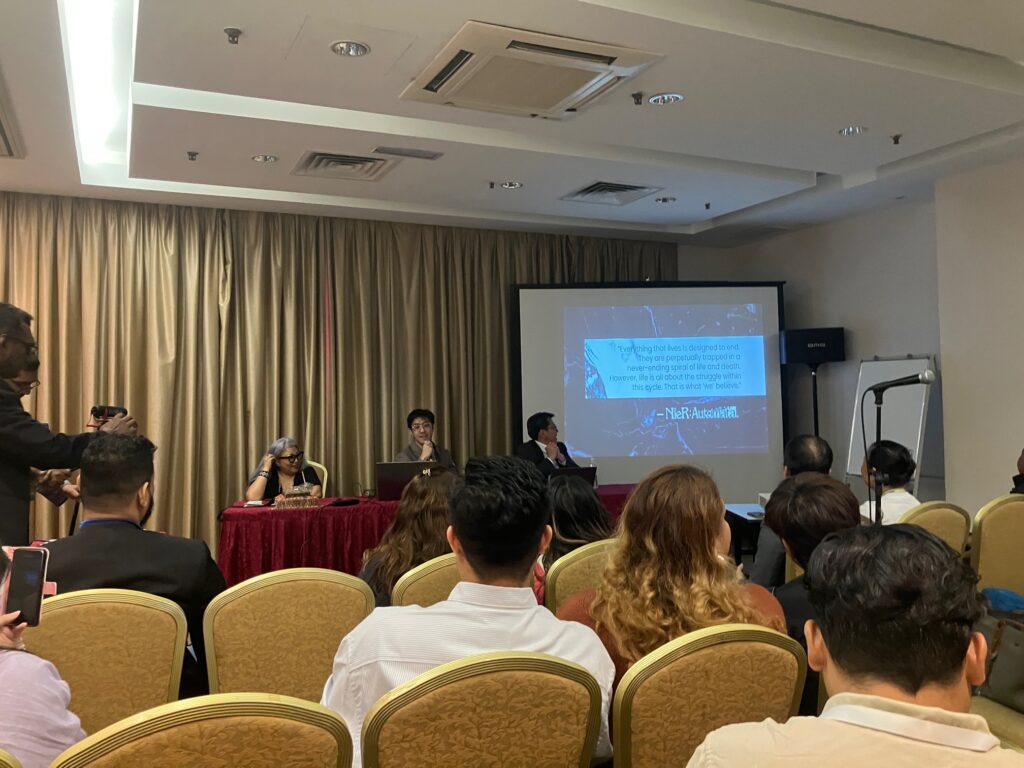
President of the Humanist Society (Singapore) Melvin delivered a lecture on how morals can be developed purely through reason and long term investment into human wellbeing as an objective metric. Likening morality to a chess match — wherein the goal is driven by self-interest, and even when putting aside ambiguous language such as ‘compassion’ and ‘kindness’ — Melvin explains how even the most selfish reasons and base instincts of survival can lead to cooperative behavior.

Presenting scientific articles and research on animals to illustrate how compassionate behavior can arise as an emergent property of social groups, Melvin extrapolates the underlying reasons to such findings to the real world, using various ASEAN countries and significant events in history as case studies to illustrate how Humanistic principles and methods primarily utilizing reason have lead to tangible progress in the aspects of economics and healthcare.

Finally, continuing to use chess as an analogy, Melvin finally illustrates how the landscape of morality is littered with sacrifices and gambits, and it is through disagreeing with the ‘correct’ moves to make that fuels discourse regarding morality. Much like how chess is a game that has not been solved, neither has the problem of morality. However, Melvin asserts that instead of succumbing to resignation in the face of no perfect answer, the only way to work toward better decisions is to continue learning, encourage constructive discourse, and to refuse complacency.

Through this speech and some audience participation activities, it elucidated the subtle and nuanced differences between the ways people thought, and also the differences between how Humanists Singapore and Humanists Malaysia tackled such discourse.

A full article and a speech on this topic may be written or delivered to the Society at a later date. That said, who could have ever imaged that quotes from games such as Nier Automata would have made it to a slide for an ASEAN conference on Freedom of Thought and Conscience?

Day Two — Religious freedom in
Singapore and repeal of section 377A of the Penal Code

To preserve Professor Eugene Tan’s ideas and to reduce information dilution, here are articles offering his views, written and spoken by his esteemed self. Here is his written OpEd regarding the Repeal of S377A, and here is a segment where he spoke on Channel News Asia. Do give him a read and listen.

Closing Remarks
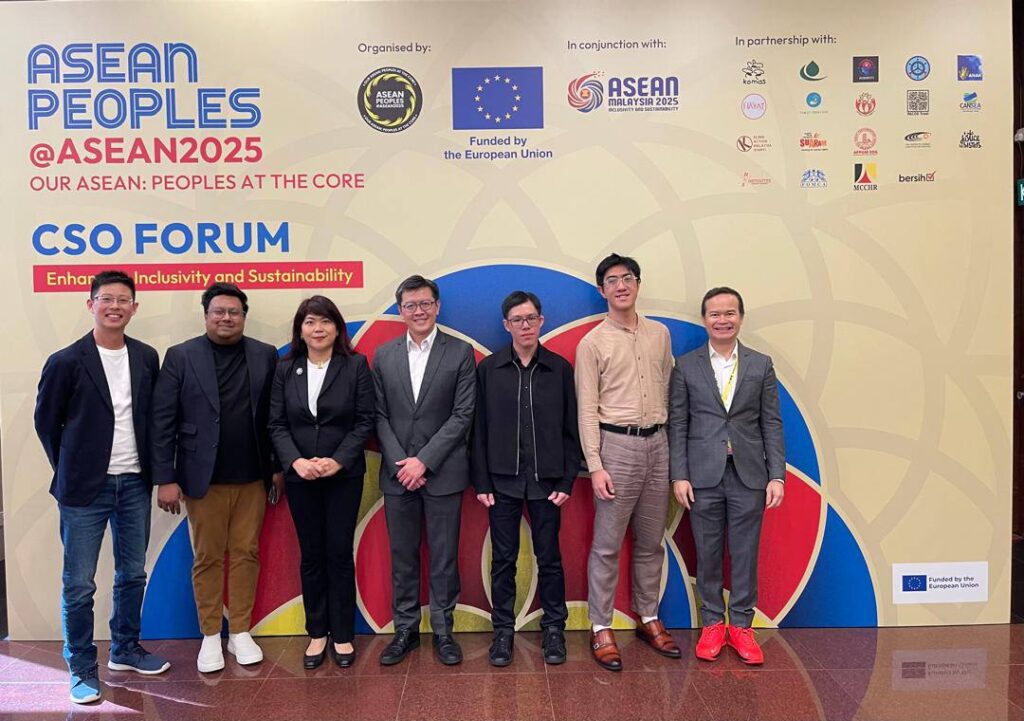
This report was written with the intent of presenting all speakers’ points and speeches as objectively as possible, while uplifting and extolling the valuable depth and breadth of information and ideas they have contributed in the spirit of edification and elucidation. While some points might not be fully agreed upon, it is undeniable that this Conference has revealed the landscape of different beliefs even within similar belief systems, with varying ideas of belief, faith and perspectives on liberty and freedom of thought.

A critiqued—opinion editorial or discussion in a form yet to be confirmed will be arranged at a later date, examining a few key points raised by various speakers through a humanistic and skeptical lens, for the betterment of discourse within the HSS community.

Special Thanks

Honorary Auditor Sreekanth Vasudevakurup for attending Day One and doing an interview with Humanists Malaysia.

Member Eugene Tay for attending Day One and Two, assisting with the write-ups of Day One, and offering pertinent advice to the EXCO on Day Two.

EXCO Member Lava, for being tour guide, planning transport, meals and various fiscal miscellany. He also kept and provided a few transcripts of the speeches from Day Two, which were used to assist in this write-up.

Assistant Secretary Ong Yew Hwee for offering valuable insight and taking notes which informed certain nuances.

The President’s wife, Ms Glena Chan, for being a moral support and camera-lady.
Secular Assembly – May 2025

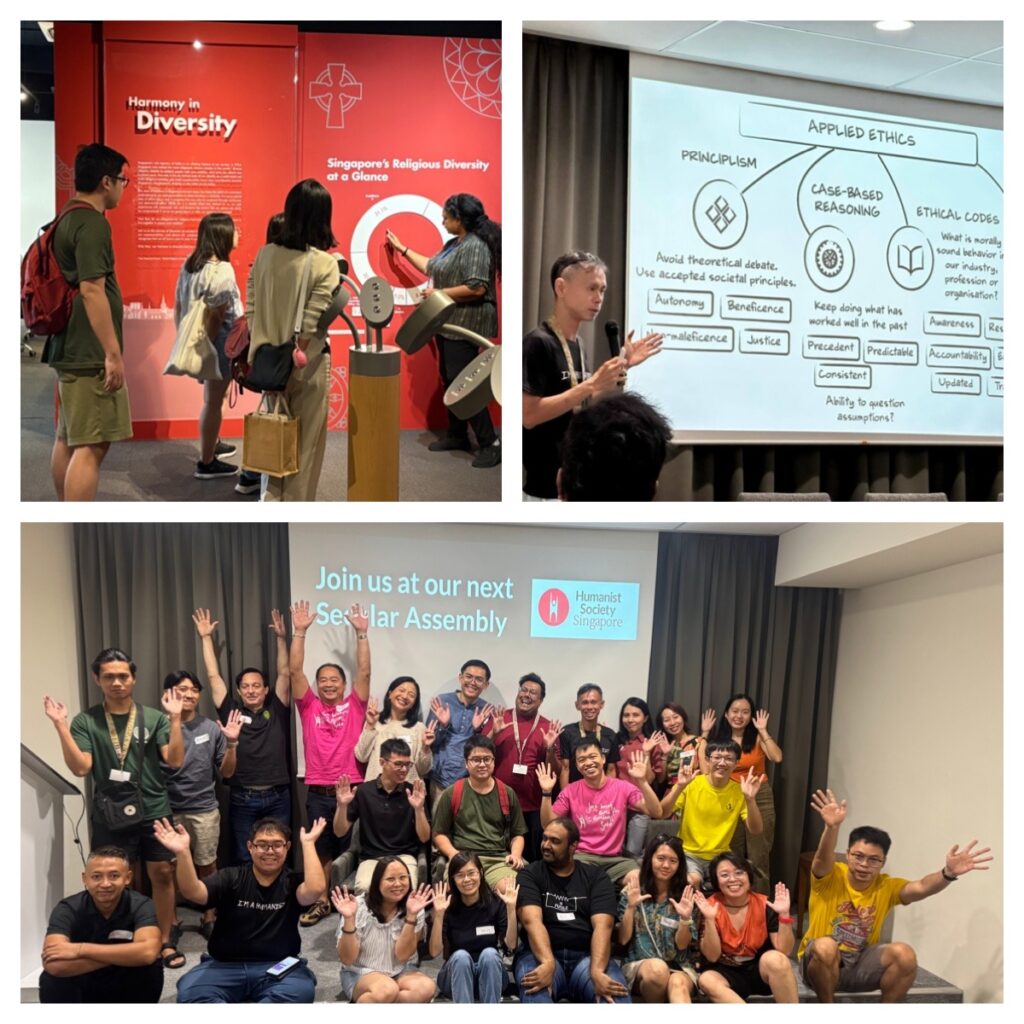
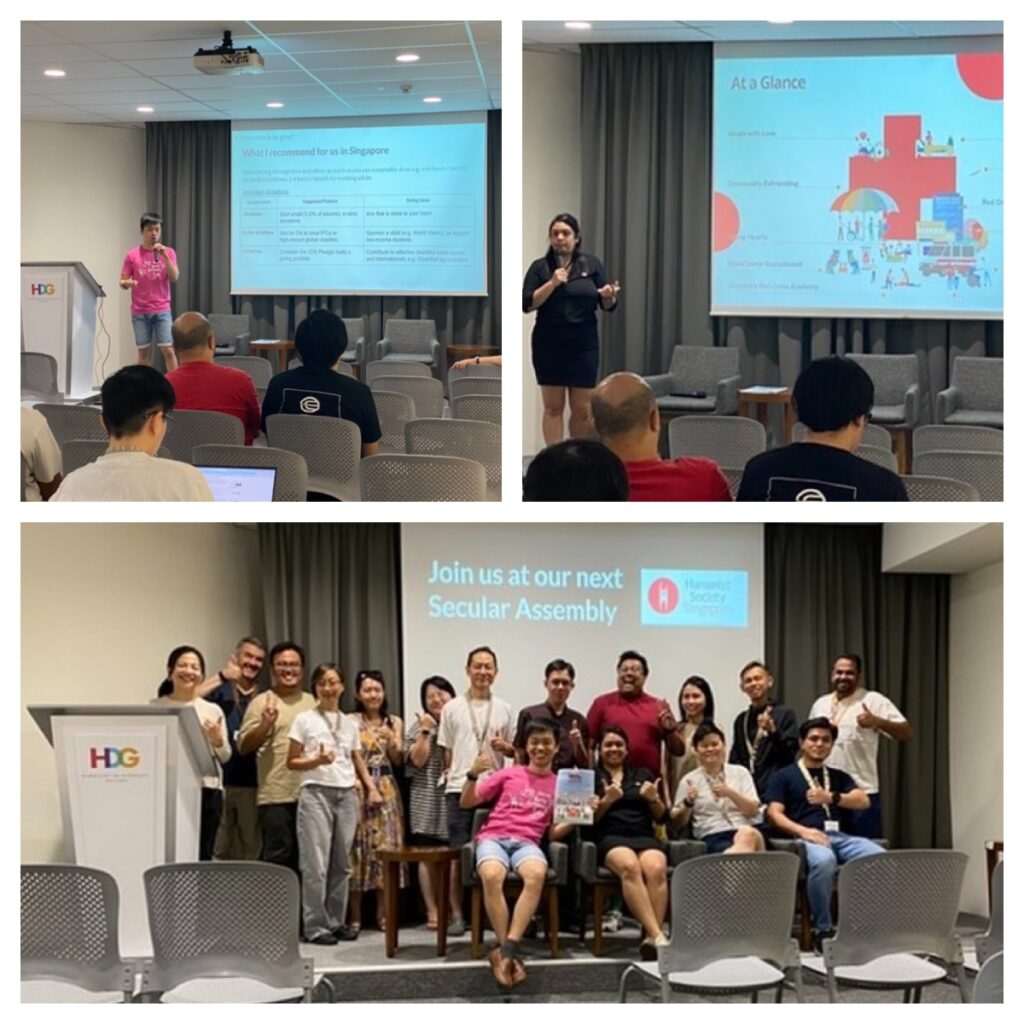
Our fifth Secular Assembly of the year, held on 24 May, was on the theme of doing good –  particularly, how reason and compassion can guide us to make real impact in the world.

The Assembly was preceded by an optional tour of the Harmony in Diversity gallery, which conveyed to participants the importance of maintaining harmonious ties among different belief groups in Singapore.

Following the tour, the main Assembly featured two engaging guest talks:

  • A presentation on Effective Altruism, a powerful evidence-based approach to doing the most good, was delivered by HSS co-founder and Secular Assembly Programme Director Dan Thio. (Thanks to the Effective Altruism Singapore group, which generously shared reference materials that informed this talk!) Dan offered his own suggestions on how Effective Altruism principles could translate to the Singaporean context.
  • Ain from Singapore Red Cross Singapore (SRC) gave an inspiring introduction to the initiatives undertaken by the humanitarian group in support of local and international causes. In Singapore, SRC extends helping hands to beneficiaries ranging from underprivileged children, who benefit from tutoring and other enrichment, to the vulnerable elderly who receive material and social support. This presentation nicely connected with the earlier talk by offering further real-world examples of worthy causes.

Attendees also took part in the Assembly’s traditions, such as a singalong session and a gratitude exercise that invited reflection on our interdependence. Join us at the next HSS event where we will continue to build the humanist community, and hopefully, a better world!

Coverage of International Humanist Conference 2024

The following articles were written following the International Humanist Conference 2024, hosted by the Humanist Society (Singapore) from 30 Aug to 1 Sep 2024.

“One of the big takeaways was how much research and how many projects exist related to secularism and interfaith harmony. It often seems like atheism and secularism are not interesting topics for study, as religious scholars tend to focus on new ways of understanding spirituality and religiosity. But at this conference, I saw excellent speakers presenting fascinating research on secularism and interfaith projects and sharing real-life experiences. They offered practical, perhaps diplomatic, approaches to handling interfaith projects.”

“Singaporeans are lovely people, especially older people. For some reason, I connect more with older people because I’m always seeking wisdom from those more experienced than me. I had great conversations with Nora and Peter from Humanists International. Nora has been exceptionally kind and helpful, always going out of her way to assist the attendees. Peter, in particular, was very interested in Ghana and how things are going here. I had many enjoyable conversations with both of them. I also met another remarkable woman, Gerda. It’s quite impressive how we are not alone in our activism. Even though we may have different experiences, the underlying principles—equity, empathy, and so on—remain the same. I enjoyed that aspect of my interactions with everyone.”

Humanist Society (Singapore) did a fantastic job hosting the dozens of delegates who came by preparing six enlightening talks surrounding Interfaith Dialogue and tapping the Ministry of Home Affairs to give us three tours tackling the history of the city’s social diversity. The Society also gave us plenty of time to mingle and befriend one another during several social nights, which my extroverted side (trust me, it’s usually not that active) appreciated!”

“I met people from the Humanist Society (Singapore) without knowing they were staff or in leadership positions. Just meeting them as members of the tour was amazing to me. I emphasize relationality, one of the main frameworks I’m constantly trying to embody, practice, and center in my work and life.

The Humanist Society (Singapore) curated various tours from various organizations. They were ushering us into a world that isn’t my own and listening to how they frame their histories. They live in a relatively young society, yet the design, intentionality, and work that went into building what they have is impressive. That speaks to human creativity and capacity—what can be achieved in what some might call a modern world.

That leads me to the Humanist Society (Singapore) itself. We were able to come in and see the work they’ve done and are still doing, especially in collaboration with Humanists International, to put together this international conference. I’m still reflecting on and cherishing that in my work here and in conversations with peers.”

It was refreshing to be on the road again and to reconnect with fellow humanist friends. The experience may not have been as new or surprising to me as it was for others. Still, I did appreciate the warm Singaporean welcome, generous hospitality, and positive, energetic way of speaking. The honesty in how Malaysians and Singaporeans express themselves resonates with me. The welcome from the humanist community in Singapore was fantastic.

In the lead-up to the conference, there were some concerns about government oversight, surveillance, and their interest in our activities—particularly about speaker visas—which might have conflicted with the human rights values held by many of us. While some concerns did come up, they didn’t overshadow the event. The immigration process was smooth, and the friendliness and dedication of the people immediately struck me.

As for my takeaway, I was particularly pleased that interfaith dialogue and harmony were central themes at this conference. The International Humanist Conference (hosted by Humanists Society Singapore) and the Humanists International General Assembly took place over the long weekend. Interfaith dialogue is a significant aspect of my Humanism and is why I joined the humanist movement. I am a humanist ambassador, someone who engages in dialogue with other faiths and beliefs rather than being inward-looking. Singapore embodies that spirit, and I left with renewed motivation and inspiration to continue my interfaith work. That message truly resonated with me.

“It was quite an experience. It was the first time we hosted such a large conference. We’ve had events like the Asian Humanist Conference, but that was on a smaller scale. That event was back in 2015 and lasted only a few days. But when we bid to host this event, we had our doubts. However, everyone on the committee unanimously said, “Let’s go for it.”

If other countries like Australia and New Zealand can do it, why not us? So, we took the opportunity and won the bid. Initially, it wasn’t very comforting because it was such a challenge. But we eventually came together as a team, and everyone played their part.

For the first time, people from all different countries came together. It was overwhelming, exciting, and yet nerve-wracking because we didn’t want to disappoint anyone. We wanted to ensure that everyone who came to Singapore would have an unforgettable experience. What we learned from organizing such a big event is invaluable. It was a great experience, and we’re glad we did it. It’s a challenge, but you’ll never know what’s possible if you don’t take that first step.”

“The Humanist Society Singapore, whose motto is: “Guided by reason, informed by evidence, and driven by compassion,” were gracious hosts. They started events on Friday, August 30th, with a guided discussion and tour of the nation’s Harmony in Diversity Gallery, where we learned that Singapore is the most religiously diverse country globally but also sees some of the least religiously motivated conflicts. This is no accident. As their presentation showed, they intentionally create shared pluralistic spaces, encouraging engagement between people of differing beliefs and educating about religion and nonbelief to reduce othering and bring people together positively.”

Other articles

A Christian among Humanists: A Chat over Easter #3

Over the long Easter weekend, Christians worldwide commemorated the death and resurrection of Jesus Christ. On Easter, the Humanist Society (Singapore) also occasionally carries out interviews with a handful of Christians have been regularly attending our events for years. They are independent-minded, well-read, and supportive of many Humanist causes. Their perspectives are valuable as a bridge between Christian and non-religious communities.

Previous interviews are with John Hui (2017) and Mathia Lee (2020) and a summary of both interviews are found at the bottom of this post.

This year, we feature Angela Ow (photo below, first from left), who has been participating in Humanist Society (‘HumanistSG’) events for the past seven years. Her favourite events were the hikes at nature parks, as well as our Humanist Cafe series.

Q: What is your religious faith and what religious services do you attend regularly?

Angela: I identify as a Catholic Christian. My father was an agnostic atheist and my mother was Roman Catholic, so I grew up with a mix but went through Catholic formation from a young age. These days, I go to a non-denominational community church, but I still attend Catholic Masses on many occasions.

Q: When did you start attending Humanist Society events? And what attracted you to our events?

Angela: I can’t remember exactly, but I think it was sometime around late 2018? That’s when I started going to the monthly Humanist Cafés and joined the hikes whenever they were held (I love hiking!). Back then, the Cafés didn’t have set themes, so the conversations just flowed naturally. I remember some interesting discussions on history, astronomy, and science. There was even one on quantum physics that totally went over my head – haha!

Q: What is your first impression of HumanistSG?  What was the biggest surprise to you?

Angela: One of the things that really stood out to me was how intellectual and analytical everyone was! I remember thinking, “Wow, these guys can really discuss very cerebral topics!” It was a little intimidating at first, but I also learnt a lot during the Humanist Café conversations.

Back then, I also noticed that there weren’t many women around – it was mostly a male-dominated space. That was a surprise to me! But it’s been really great to see more women joining Humanist Society events nowadays. It feels more balanced than before, and it’s nice to have a wider mix of perspectives and experiences in the discussions.

Q: How did the humanists, atheists and agnostics etc. react when they learnt you are a Christian? How did you respond to them?

Angela: People are usually surprised when they find out I’m Christian. Some get curious and ask why I’m volunteering with the Humanist Society. Right now, I help out as a Humanist Café facilitator as well as organize bimonthly hikes.

I volunteer because I find these events meaningful – they bring HumanistSG people together and help create a sense of community and friendship. This is especially important since most in the Society do not join religious groups, so they may not have access to the many fellowship and bonding activities that religious groups offer.

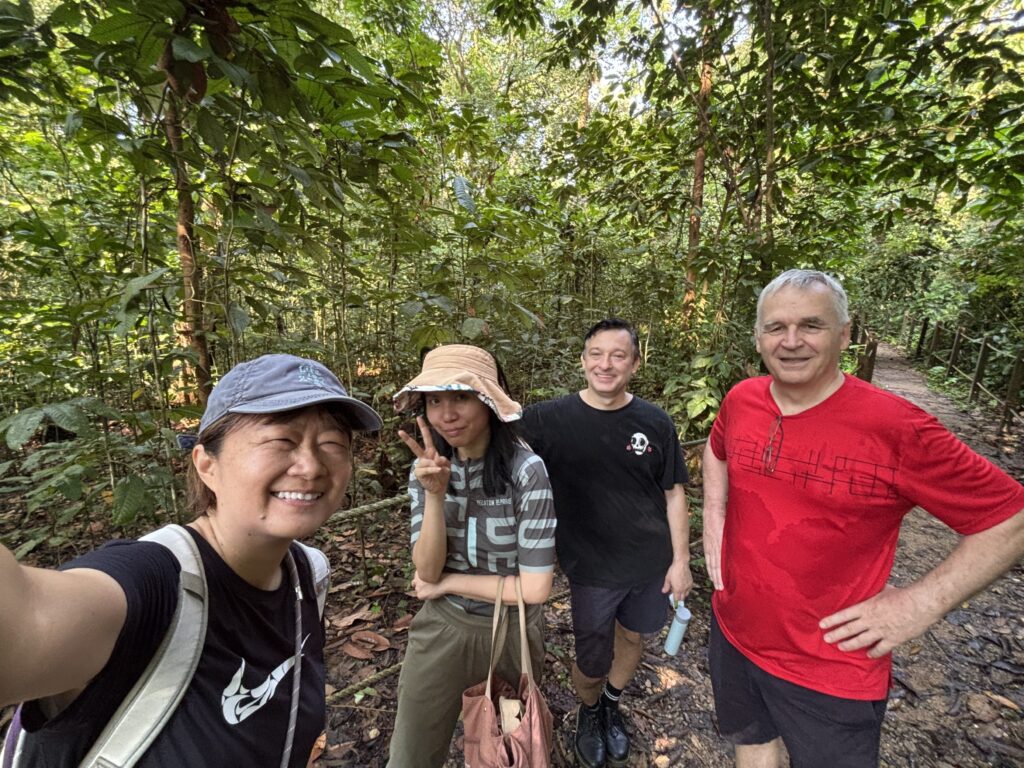
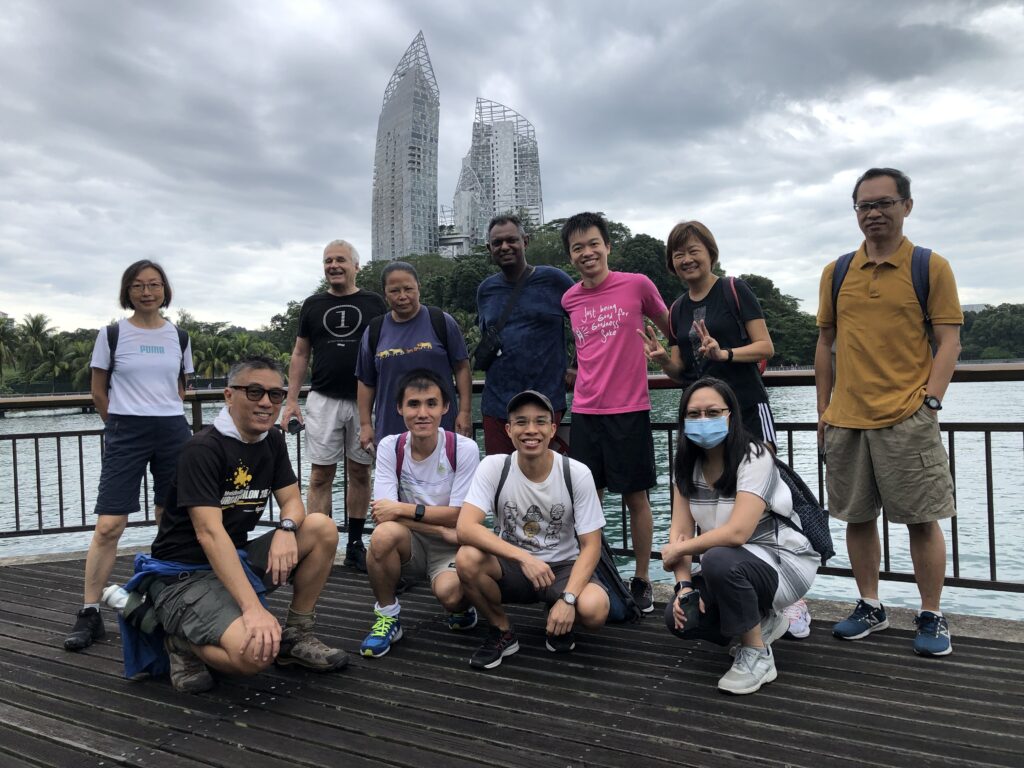
Photo above: Angela (standing, 2nd from right) at a HumanistSG hiking event.

Q: Did you feel hurt whenever the Humanist Society releases statements that are critical of religion/religious institutions?

Angela: I don’t think I’ve come across the Humanist Society putting out any statements that were openly critical of religion or religious groups. From what I’ve read, the statement releases have always come across as fair and balanced. What I like is that they highlight the perspectives of non-religious people – views that sometimes get overlooked in our society as Singaporeans with religions still largely outnumber those without.

Q: What is the biggest misunderstanding that many atheists, agnostics, humanists have about Christians?

Angela: I think a lot of non-Christians tend to see Christians as one monolithic group – like everyone believes the same things and acts the same way. To be fair, we all kind of do this sometimes with groups we’re not a part of (I think the term for it is “outgroup homogeneity bias”). It’s common for people to mainly come across Christians who are really active in converting non-believers – whether in public or within their own circles – so it’s easy to assume that all Christians are like that. But that’s not the case. Different Christians choose to live out their faith in different ways, and it’s not a one-size-fits-all thing.

For me, one thing that stood out in the stories of Jesus was how he was always on the lookout for people in the margins of society, people who didn’t fit in, and actively reaching out to them, even if it meant breaking social norms of the time. This aspect of Christianity resonates with me and living out my faith as a Christian means seeking to do the same. That is quite different from seeking the conversion of others, which is often considered by many to be the mainstream or core pursuit of Christianity.

Q: What is the biggest misunderstanding that many Christians have about non-religious people? (atheists, agnostics, humanists etc.)

Angela: I’m not sure if it’s the biggest misunderstanding, but I’ve come across some Christians who think that people without religion don’t have a moral compass – or worse, that they’re amoral and don’t care about doing what’s right.

From what I’ve seen, that’s just not true! Religion and sacred texts can be an important source of guidance, but they’re not the only ones. A person’s sense of right and wrong is also shaped by many other things – their upbringing, the values of society, culture, their lived experiences, and an education that encourages critical, rational and moral thinking.

Take my father, for example. He’s an agnostic atheist, but he’s one of the most honest and considerate people I know – especially for the less abled. Not having a religion won’t make a person less moral or amoral. We all have a conscience, and life is about following one’s conscience to the best of our ability.

Q: How do you think our mutual misunderstandings can be resolved?

Angela: I believe having an open and honest conversation is the best way to go. If we are willing to set aside our preconceived notions, make the effort to see things from the other person’s perspective, and perhaps the hardest part – the courage to be wrong (let’s face it, we all have blind spots and biases), I believe a lot of our misunderstandings can be resolved.

The point of a conversation isn’t about agreeing on everything. We may not see eye to eye as we are all shaped by different lived experiences, ways of thinking and personalities. But that should not preclude us from working together for good. 

Whether it’s doing good because of one’s faith in God, or doing good for goodness’ sake, we all have something to contribute to our shared humanity.  I believe religious and the non-religious have a lot more in common than we think.

Past Interviews

John Hui (2017): John is drawn by its commitment to critical reasoning, secularism, and support for the non-religious community. Despite holding Christian beliefs, including in the resurrection of Jesus, John uses evidence-based reasoning to reconcile his faith with humanist values, engaging respectfully with atheists and agnostics who often question his stance. He sees the Society as a valuable platform for promoting rational discourse and pluralism in Singapore, and believes it can empower progressive religious individuals to stand against religious fundamentalism.

Mathia Lee (2020): Dr Lee sees her faith as a personal moral compass rather than a set of Western-influenced rituals, and appreciates HSS’s respectful but critical stance on harmful religious practices. She highlights the importance of mutual understanding through dialogue, emphasizing that both Christians and non-religious people often hold misconceptions about each other that can be resolved through open, respectful engagement.

Guidance by Reason: Texas Sharpshooters & Confirmation Bias

Guidance by Reason is an initiative founded by the Humanist Society (Singapore) to impart the craft of evidence based reasoning in the spirit of humanism and public good. Guidance by Reason is a single step toward the goal of the HSS being a bastion of reason and rationality within Singapore, making accessible such skills to the general public for no profit, all for the endgoal of keeping the spirit of critical thinking in our secular society not only alive, but thriving.

The broad side of a barn in Texas is riddled with bullet holes. Wood shavings and splinters are scattered around the grass, a testament to just how many shots have been fired. On the wall of the barn, are target markings drawn in chalk. Every single bullet hole darkens the bullseye of each target circle.

Finally, a child could bear his awe, admiration and curiosity no longer. He must see this marksman in action, and marvel at his impeccable accuracy. The Texas Sharpshooter accedes to the child’s request, and in the midday sun, accompanies the child a few yards away from the barn.

The marksman looses six shots from his firearm in quick succession, the bullet holes left in the barn wall still smoking. The marksman pulls some chalk out of his pocket, and draws targets around each hole in the wall made.

Bullseye.

Ridiculous as the story above is, how often have we done the same to events that have happened in the past? We have seen people all around us do the same. A cultural example includes the peak of the Satanic Panic in the 1980s, when everything unconventional such as rock music, Dungeons & Dragons, and video games were attributed to satanic or devilish influence, and increases in violence, drug use and alternative lifestyles were blamed on media and the evolving youth demographic at the time. However, only now, can we look back in hindsight and confidently say that no, Pikachu wasn’t — and isn’t looking to feast on a kid’s soul. Much of those changes came about from factors such as an increasing connectivity to the world beyond thanks to the Internet, faster paces of life, and changes in the structure of family nuclei. However, it was all too common to see many ascribe the cause for that incident to certain factors, only after the fact.

Imagine if your dad drove a red Toyota. Now, envision the key impressions you might have of the Toyota brand. From the floor, words like “Common”, “Reliable” and “Cheap” sprung up. Now, each time you see a red Toyota, perhaps you might think, “Ah, that other person is driving a red Toyota because they are common, reliable and cheap,”

A harmless and simple enough assumption, but the above has illustrated how easily one might fall for confirmation bias. As a shortcut that works in tandem with the Texas Sharpshooter fallacy, confirmation bias is one of the mental shortcuts our brain takes for the path of least cognitive resistance. Benign in small doses, until it starts to affect the decisions we make, ranging from the shampoo we choose, to studying how exactly the 2007 — 2008 financial crisis actually happened.

After a little spiel, presenting different types of biases and fallacies made in daily life and history, all participants were given a topic pertaining to current local affairs, ranging from influences on media today, to the Singaporean education system and housing market. Their task — to defend a predetermined point to the end, no matter how ridiculous it was. After all, the costs of living around the world could be rising because humanity is collectively being punished by an invisible goblin hiding in a closet for transgressing against its will. Why not?

There were asinine and incredulous arguments being made in favor of certain points. Some utterly hilarious, some rather well reasoned and thought out. Ultimately, the point was to demonstrate how easy it could be to tunnel vision and fixate on a single point as a primary cause for a phenomenon, as long as there was some measure of emotional and cognitive investment involved — a point well illustrated during the session, and I am proud to say that the entire session was a splendid success.

I would like to thank everyone who participated for making the event a success, and for providing me feedback. Guidance by Reason has been an iterative process over the course of practically a year, and this format and iteration has proved itself to be the most well-received and successful thus far. Certainly a step in the right direction.

I would like to thank my wife for being my idea trampoline. I have bounced many ideas off her, and she has given me rather good feedback.

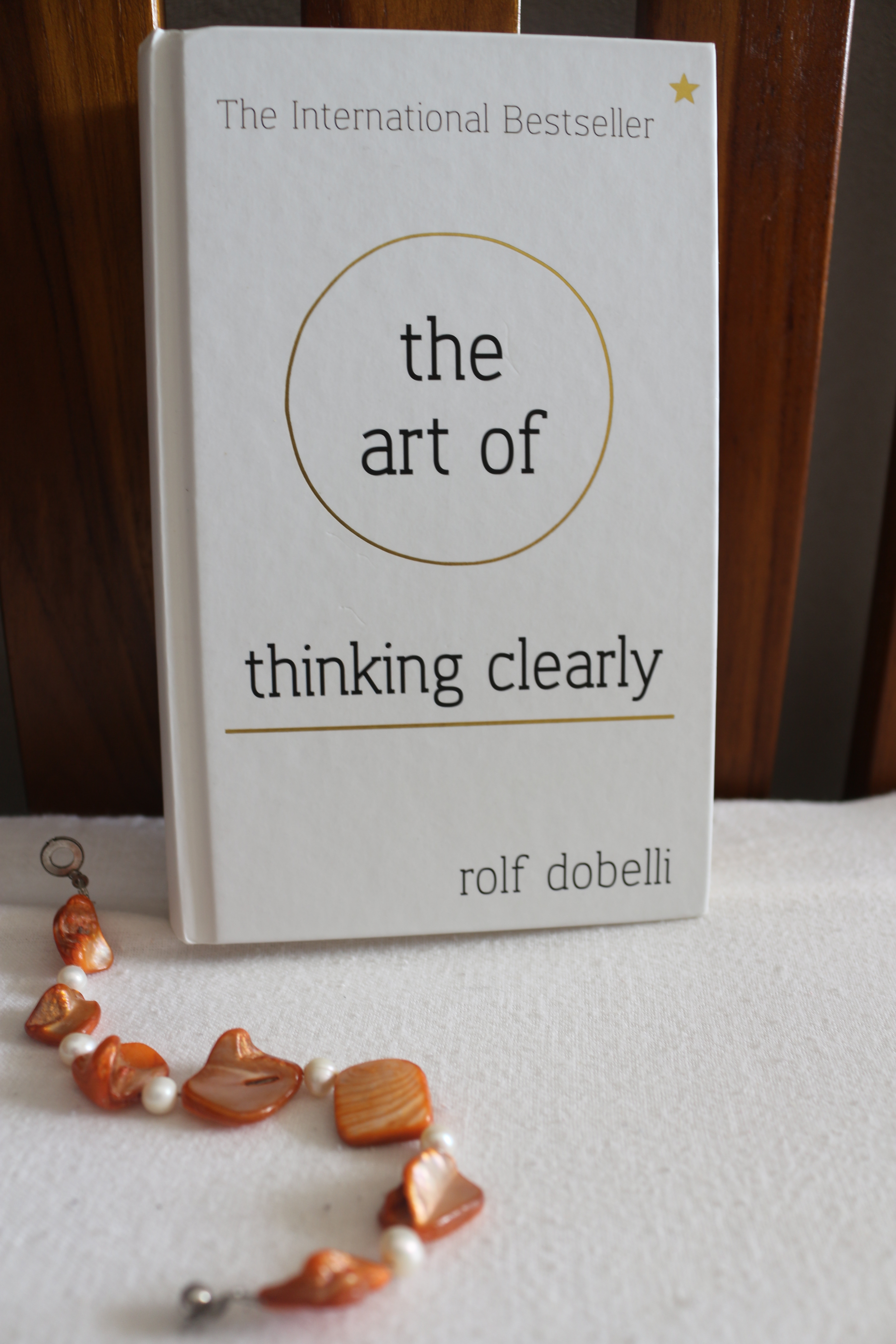
Recommended further reading for a jumping point: The Art of Thinking Clearly by Rolf Dobelli

Image Credits: https://vaniecastro.com/2015/03/11/2015-book-1-the-art-of-thinking-clearly-by-rolf-dobelli/

Secular Assembly – April 2025

Our fourth Secular Assembly of the year, held on 19 April, responded to a fundamental question. Without depending on a supernatural authority, what frameworks can non-religious people use to live an ethical and meaningful life? 

A look at the philosophy of ethics

Our guest speaker Adrian Chia provided a whirlwind introduction to ethical approaches and acknowledged their links to humankind’s history of cultural traditions and intellectual inquiry. Adrian, a regular volunteer at HSS with a background in philosophy, ethics, and psychology, discussed four main branches of the philosophy of ethics: metaethics, descriptive ethics, normative ethics and applied ethics. Diving into applied ethics, the study of how moral principles can be used in real-life situations, he discussed principlism (an approach that prioritises commonly accepted principles such as justice and autonomy), case-based reasoning and ethical codes (e.g., codes of conducts followed by professions). 

Beyond the Golden Rule 

The study of ethics gives us a plethora of concepts. Want a quick takeaway that can be applied to daily life? In terms of personal and specific recommendations to humanists, Adrian highlighted the Golden Rule and its variations as useful moral tools.

A formulation of the Golden Rule is “Treat others as you would like others to treat you”. Related principles have arisen across the major faiths across the world, which arguably indicates that these principles are rooted in collective human experience. Beyond the Golden Rule, Adrian noted its limitations and certain variations to consider: the Silver Rule (“Do not treat others in ways that you would not like to be treated”) the Platinum Rule (“Treat others the way they would like to be treated”) and the Rhodium Rule (“Think about the entire ecosystem”).

Throughout the talk, members of the audience added their perspectives on varied topics such as karma, sin and gender biases. Attendees were also polled on a variety of trolley problems that challenged us to determine what to do in a situation where individual rights and collective good seem in conflict. As Adrian put it, readymade answers to complex ethical questions are in short supply: “there is no Ten-Year Series”.  

Adrian’s recommendations for further reading and exploration included:

  • Sophie’s World by Jostein Gaardner – an introduction to philosophy in novel form
  • The Moral Landscape by Sam Harris – a neuroscientific look at morality
  • The Moral Landscape Challenge, an essay rebutting the book
  • Three Worlds Collide by Eliezer Yudkowsky, a short story on metaethics
  • The Effective Altruism movement, which provides a framework for identifying effective charities

In addition to the guest talk, we continued the tradition of previous Assemblies by holding a fun singalong and a closing meditation which united our group in reflection on everyone’s interdependence within wider society. For more fellowship and thought-provoking conversations, join us for the next Assembly as we continue to build the Humanist community!

Keeping our elections secular

In the midst of the Singapore General Election 2025, the Humanist Society (Singapore) supports the call by political leaders and the government to keep religion and politics separate.

Singapore is a diverse multiracial and multireligious country and includes a significant number of non-religious residents.

A secular state protects all religious communities, as well as the non-religious, because it ensures everyone’s freedom of belief and freedom from belief is protected, and that no group is privileged over another.

Singapore is not immune to the push and pull of global identities, be it religious, racial, cultural, political. Singaporean voters are highly connected to the world through the internet.

Thus, beyond the government’s call, we urge Singaporeans from all religious communities to also support efforts to keep our politics secular.

Secularism is the best guarantor of freedom of religion.

Hanging out With Humanists [ 4th April 2025 ]

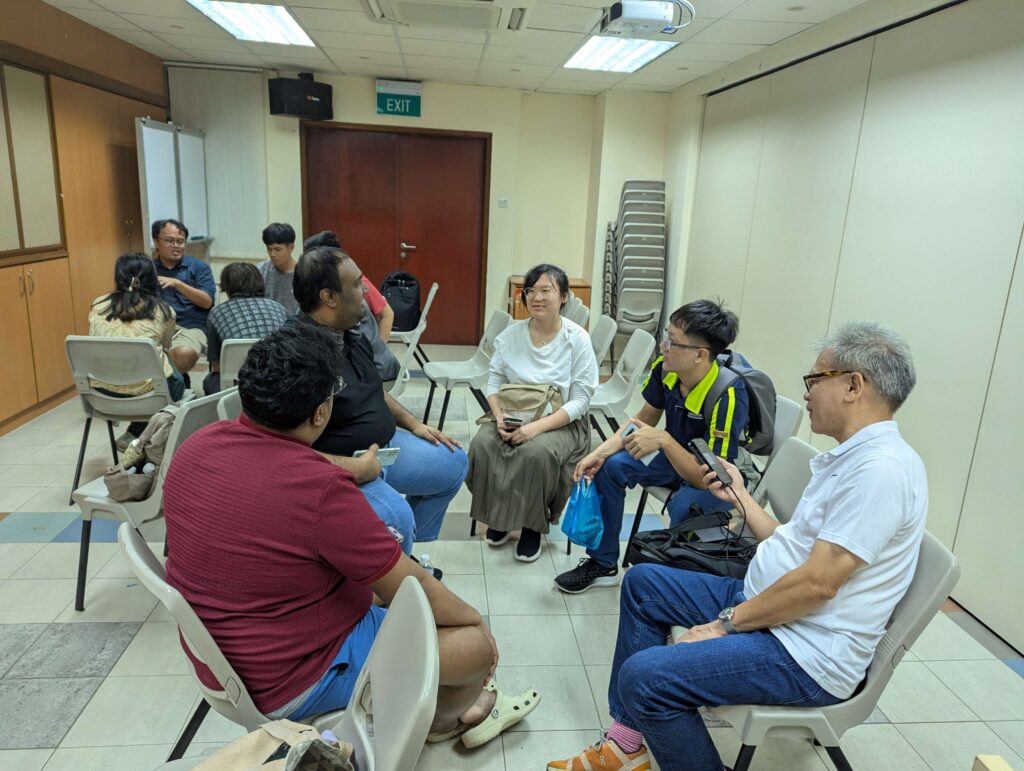
The April Hanging Out with Humanists session was nothing short of meaningful. As conversations flowed across the table, what emerged was more than just dialogue—it was a shared moment of reflection, openness, and connection.

On Religion as Story and Culture

Yew Hwee Ong shared a deeply thought-provoking perspective that emerged right at the end of the evening. While firmly identifying as an atheist and secular humanist, he expressed a new appreciation for the influence religion holds—not as truth, but as a powerful narrative form deeply embedded in culture.

“To me, religion should be seen like fiction—much like One Piece, Attack on Titan, Lord of the Rings, or Harry Potter,” he said. “These stories, while fictional, offer guidance, inspiration, and commentary on real life. Rituals, then, become simulations of those stories—like walking through a living museum of mythology.”

He acknowledged the undeniable impact of religion on human behavior and the structures of society—both positive and oppressive. The key difference, he noted, is that religious believers equate their stories with reality, while secular humanists treat them as cultural narratives that still deserve thoughtful engagement.

On Morality, Disagreement, and Mutual Respect

Melvin added that the evening was lively, especially with the presence of three newcomers who each brought unique perspectives. He mentioned the “merry, respectful disagreements” with Yew Hwee, especially around how we define and measure morality.

In response, Yew Hwee reflected with sincerity:

“I truly respect your points. They made me think seriously about how we can make better decisions by balancing morality, utility, and the well-being of people in different contexts.”

It was a beautiful example of how disagreement, when held with respect, can deepen understanding rather than divide.

On Connection, Care, and Reaching Out

Meanwhile, on the other side of the table, Lava shared insights into the emotional and social outreach strategies of religious institutions. He pointed out how adept these institutions are at making people feel seen—stepping out of their own spaces to meet others where they are, and building genuine human connection.

“We talked about how religious institutions blur the lines between secular and sacred, reaching into marketplaces and even influencing the upper echelons of society. There’s a lesson here for us: we, too, need to step out of our comfort zones.”

Lava emphasized the importance of noticing members of our own society who may be silently struggling. A simple check-in message or an open ear can mean the world. He reminded us that:

“Sometimes the conversation becomes more important than the person—but it shouldn’t be. The person should always come first.”

What made the evening truly special, he reflected, was how personal the conversation felt. “I got to know some of our members more deeply than I ever have since joining,” he said.

A Night of Thoughtful Connection

The HOH reminded us of what makes humanist spaces meaningful: not just the sharing of ideas, but the care and curiosity we extend toward one another. Whether through challenging perspectives, respectful disagreement, or heartfelt conversation, we continue to learn not just how to think—but how to be human, together.

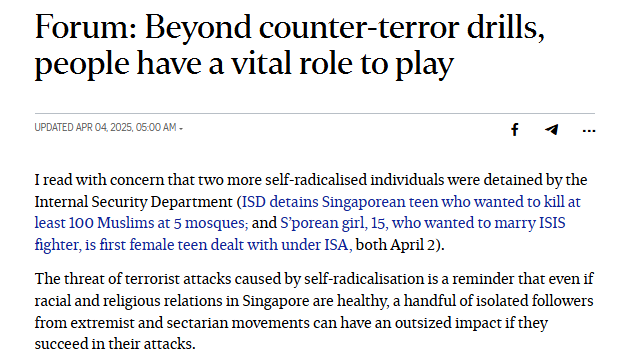
ST Forum: Beyond counter-terror drills, people have a vital role to play

The Humanist Society (Singapore) submitted a letter to the Straits Times Forum:

In the letter, our President Nora expressed concern over the recent cases of self-radicalised individuals in Singapore.

She suggested NGOs, including various interfaith groups, can conduct closed-door table-top exercises to simulate first responses to various scenarios of terrorism aimed at weakening social cohesion. And if such exercises already exist, these exercises can be expanded to involve more NGOs and self-help groups.

She added that “scenarios can be based on past attacks that have happened abroad. Scenarios should also change according to how terrorists are adapting to the latest security measures.”

“During an exercise, NGOs and self-help group leaders can take the lead as “social first responders” in the information space, simulating and coordinating their statements and publicity materials, including both social media and mass media,” she said.

2025 AGM [ 29th March 2025 ]

This year’s AGM was a meaningful gathering, even though we did not meet the required quorum to proceed with the proposed constitutional changes. Nonetheless, the session went ahead with the official agenda and gave us much to reflect on as a community.

The President opened the AGM with an honest and heartfelt speech. She spoke candidly about the doubts she faced in discharging her responsibilities—and the courage it took to step forward anyway. She outlined three key pillars of focus for the year ahead:

  1. Community Building
  2. Education and Advocacy
  3. Outreach and Engagement

Drawing from the history of the Humanist Society (Singapore), she reminded us that HSS was itself a movement born from a movement—emerging from the aftermath of the AWARE saga. In her words, “Relevance is not inherited—it is created.” Quoting diplomat Bilahari Kausikan, she emphasized:

“Small city-states have no intrinsic relevance to the workings of the international system. Relevance is an artefact, created by human endeavour, and having been created, must be maintained by human endeavour.”

She urged members to think beyond waiting for the next ‘saga’ to define us, and instead, take deliberate steps to shape our relevance in today’s context.

“HSS is a movement born from a movement—a community that emerged from a transformative period and now has the power to shape its own future. We must ask ourselves: What is our story now?”


Following the President’s opening address, the AGM proceeded with the official agenda:

  • Confirmation of the Minutes from the 2024 AGM
  • 🗓️ Summary of Events and Activities in 2024 — a year marked by thought-provoking Conversations on Humanism, successful Secular Assemblies, community socials, and impactful outreach initiatives
  • 💰 Adoption of the Auditor and Treasurer’s Reports, affirming the Society’s financial health and transparency

🗳️ The election of the Executive Committee for 2025/2026 was conducted smoothly, along with the appointment of Honorary Auditors. Congratulations to the newly elected EXCO members—we look forward to their leadership in the coming year!

Members were also briefed on ongoing key programmes such as the Secular Assembly and Conversations on Humanism series, followed by a preview of major events planned from March 2025 onwards.

The floor was then opened for items submitted by members, followed by an engaging and generous Q&A session, allowing for open discussion and feedback.


The old guards of HSS came to give their support.