Science and Philosophy in the Medieval Middle East (Summary)

15729746677_baa81f8c93_z

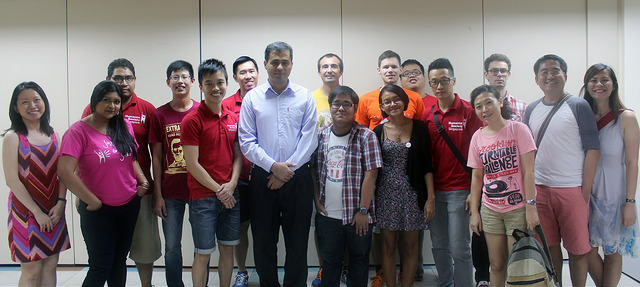
This is a summary of a talk given by Hossein Roshandel on 30 November, 2014, on the Islamic Golden Age and its contributions to science and philosophy, at the invitation of Humanist Society (Singapore). Mr. Roshandel is an Iranian and a Postgraduate Student in School of Civil & Environmental Engineering, Nanyang Technological University since Jan 2012. The event was held at OnePeople.SG.

Hossein started his presentation with a basic introduction about the Middle East region. The “golden age” of Islam, remembered for its great accomplishments in science and innovation, is roughly defined as the era between two major invasions, the Arab conquest of Persia in the 651 and the Mongol sacking of Baghdad in 1258. The period also coincided with the Middle Ages in Europe. Many of the great thinkers in the Islamic world at that time were in fact Persians using the Arabic language to write their works. [Read more…]

Non-religious funerals

1980346_10151987565575848_7882676_o

The death of people we know and love is often shocking and painful. Offering a dignified and meaningful way to bid farewell to those who have lived without religion is important.

Our organisation, at this point of time, do not have the capability to offer humanist funerals and memorial services. However, non-religious funeral packages exist in Singapore and have been in business for many years. We have a compiled a list for your reference, including contact numbers and rates (where available). However, information on the websites are not exhaustive and we do not have complete knowledge of the packages. Please contact the providers for more information.

Members of the humanist community have asked us if the Mandai Columbarium provides a place for deceased people who did not profess a religion or did not choose to be affiliated to any religion. To our knowledge, there is no differentiation between religions (or the lack of) for the deceased in the government managed columbariums. According to the FAQs on the NEA websitethe niches are also allocated sequentially.

[Read more…]

BLOG: Drinks, Poetry & Moonrise

Thirty people attended our event “Drinks, Poetry & Moonrise” on Wednesday night.
This first of its kind HSS event straddles science and culture, highlighting the essence of the Mid-Autumn festival. Mid-Autumn festival (中秋节)is associated with the fables of Chang’er (嫦娥) , Houyi (后羿), Jade Rabbit (玉兔) & Wugang (吴刚) ; lantern quizzes (打灯迷) that see wisdom permeating within the community ; and the historical significance of secret messages within mooncakes that culminated in the founding of the Ming Dynasty.
Group
The scientific activity of photographing the moonrise was de-emphasized, for participants did not bringing their own cameras, but the chief culprit was the shy moon herself, preferring to hide behind the overcast sky for most of the evening. Mooncakes, pomelo, water-caltrop (菱角) , drinks and good conversation took over naturally, before Huifen brought on her poetry recital.

[Read more…]

More from Human Worth and Dignity

A few weeks ago, we provided the summary of our event, Human Worth and Dignity.

Here are the video recordings of the speakers for your viewing pleasure.

[Read more…]

BLOG: World Humanist Congress 2014

 This year, the World Humanist Congress took place in Oxford, England from 7 – 10 August. Our committee member Huifen attended the Congress – here is her experience of it. [Read more…]

Grappling with Gay Rights

This write-up is written by Mr. Sharad Kumar Pandian, a member of our society as well as a student at the Nanyang Technological University. The write-up is first posted on Mr. Sharad’s Facebook as a note, you may read the latest version here. [Read more…]

BLOG: A Summary of Human Worth and Dignity Talk

human worth

By Grace Boey

On 3rd August 2014, the HSS hosted a talk — Human Worth & Dignity: Two Stories of the LGBT Community — at Singapore Management University’s Administrative Building. Guest speakers Alex Au and Professor Lynette J. Chua spoke to a full house of about 120 audience members: the biggest turnout yet for an HSS event. [Read more…]

Book Review: “The Little Book of Atheist Spirituality”

Screen Shot 2014-06-04 at 11.07.23 PM

Humanists are often asked: Don’t you need religion/ God/ Gods to be spiritual?

I don’t think so, and neither does Andre Comte-Sponvile (“ACS”).

In his book, “The Little Book of Atheist Spirituality” ACS discusses this very question of atheism and spirituality. There are  4 main sections:

1. Can We Do Without Religion?

2. Does God Exist?

3. Can There be an Atheist Spirituality?

4. Conclusion: Love and Truth [Read more…]

Creationism in NTU (Part I)

Sharad Pandian attended a creationist talk in Nanyang Technological University. Here are his reflections, published in the NTU student union publication, the Tribune. The HSS interviewed Sharad as well, in Part II.

creationist slide

Science is nearly universally recognized to be of paramount importance in today’s society. From the technology in our phones to the ways we solve crimes, we are reliant on science, and by extension scientists, and the scientific method. However science is not the sole system of belief formation that we use. The clash of these systems with science is both vastly important and endlessly fascinating, and I shall explore some of these themes here.

[Read more…]

Creationism in NTU (Part II)

Sharad Pandian attended a creationist talk in Nanyang Technological University on 20 March, 2014. We caught up with him to find out his thoughts on the talk. Sharad is a fourth-year physics major from NTU, with a second-major in philosophy. He regards himself as a secular humanist and has a keen interest in social justice issues. 

He also wrote to the NTU student union publication highlighting this creationist talk. 

flyer

What was your reaction to this talk promoting creationism in NTU?

Sharad: I am appalled and deeply saddened. Perhaps I’m just a naive optimist, but I still hold out hope that it is possible for there to be a religious believer who is perfectly rational. Someone whose beliefs fuse together the best of science and philosophy with religion. Unfortunately, this event was no exhibition of such lofty ideals. Within the first 5 minutes, the speaker had declared that evolution has no scientific evidence (I remember gasping when he said this) and I spent the rest of the evening in shock. You always hear about how fundamentalists keep trying to inject creationism into schools in the US, but I’ve always considered this to be a problem far, far away. To encounter creationism in Singapore, and in a university setting no less, is extremely troubling.

Do you see the creationism movement is gaining pace? How so?

Sharad: The fact that serious people (including the three speakers at this event) believe that evolution is dubious seems to indicate that the creationist movement is larger than expected. It was also recently pointed out to me that there is a public exhibit at the visitor’s centre at St. Andrew’s cathedral. I can’t comment on whether the movement is gaining pace or whether we’ve been blind to how big it has been until now, but either way this isn’t something that we can write off as benign.

By ruling out the censoring of the creationist agenda, what is your preferred way of engaging with creationists on this topic? 

Sharad: Well I should probably mention why I think censorship isn’t the way to deal with this issue. The first reason is moral and has to do with my stance that no one should be prevented from saying or hearing something. This emerges from my commitment to free speech.

The second is more pragmatic and has to do with the fact that censorship is far too often a double edged sword. Sure, we can ensure that creationists aren’t given science platforms. However, it doesn’t seem possible to bar people from espousing creationism at religious events (such as this one). Moreover, the way to combat these views is with more freedom. Let creationists hold their events. In response, others should be allowed to hold their events where they expose why evolution is in fact our best theory about our origins. If we try to censor creationists for misrepresenting science, can creationists try to censor anti-creationist events for hurting their religious sentiments? Who decides what acceptable censorship is? I don’t know, but that’s a road I think we’d be better off not treading.

One reason why scientists do not debate with creationists is that such debates will give creationism credibility and status as equal and valid scientific theories. By ruling out the idea of censoring creationism, how else do you think we can promote proper public science education?

Sharad: This is certainly an important question, one to which I do not have a complete answer. It’s certainly a valid point that engaging with creationists might appear to confer some legitimacy. However, we have to think of people who live in bubbles and gain information only from creationist speakers. Debates or at least public talks might be the only avenue through which they can hear about evolution and the weaknesses of creationist ideas.

Of course, there are some people who will simply choose to ignore all contrary information but censorship isn’t going to do much for them anyway. If they’re taught that the universe is created 6,000 years ago, in their churches and by authority figures in their lives, simply censoring creationism will be of no avail. A more active approach is essential (and we have to accept that some people cannot be reached; not even the long arm of science can penetrate a sphere of wilful ignorance)

creationist slide

Photo: A slide used in NTU during the event ‘Life on Earth: Intelligent Design or Chance?’

How long was this event publicized for? In your essay, you  suggested that the publicity period was quite some time.

Sharad: The event was publicized about three weeks in advance on Facebook, which is considerable in itself. But the true extent of the publicity is evidenced by the large number of people who handed out flyers for the event. In two different classes, classmates handed out flyers after class to everyone who was interested. Clearly, they were reaching out to any and everyone they could. So it’s safe to say it was publicized fairly extensively.

What is your impression of the initial outreach of the seminar? 

Sharad: I’ve attached the flyer they handed out. In retrospect, I should have known by the event sub-heading (“Intelligent design or chance?”) and by the fact that it was hosted by the ‘NTU Campus Crusade for Christ’, but I still held out hope that the speaker would show that faith and science could be accommodated simultaneously. No one really offered much information beyond the flyer and so I had no solid idea about what to expect.

What were the main topics introduced in the seminar? 

Sharad: The primary speaker was Dr. Thian Yew Gan, an engineer, who spoke about why the Christian God was the best answer to questions regarding our origins. Throughout his talk, he tried to show that the probability of life existing was very low and supported this by mentioning how the water cycle, greenhouse gases, etc., were all essential to life. He then referenced the strong anthropic principle to claim that the fact that life is very improbable coupled with the fact that life exists, implies the presence of a creator. Even where the science was fine, the inferences drawn from them were dubious. For instance, he completely ignored the weak anthropic principle, which would have shown that the low probability of life is hardly a concern.

The majority of his talk revolved around showing that evolution was a bad theory. He went over old and debunked examples of the evolution of the eye as well as the flagellum. He mentioned that microevolution was proven but not macro-evolution (I think the implicit reference here was to James M. Tour, but it is conveniently forgotten that he’s a synthetic chemist, not an evolutionary biologist). He also made some fairly terrible arguments against evolution such as the ‘missing’ intermediate fossils and the infamous ‘if man evolved from apes, why are there still apes around?’ rhetorical question.

Another component of his talk was to point out apparent truths in the bible that couldn’t have been there unless it was inspired by divinity. To support this, a video was played where the fact that the bible mentioned 12 anisotropic crystals was apparently supposed to indicate ancient wisdom. Perhaps I was biased because of being an unbeliever, but none of this seemed remotely convincing.

(There was also a second shorter talk by an accounting professor Qu Tianshu, but it thankfully involved the speaker’s lived experiences alone and so didn’t have a barrage of scientific inaccuracies. Implying a libertarian conception of free will was as contentious as it got).

There was a Q&A panel after the two talks where the speakers were joined by a theologian Dr Lewis Winkler. I thought the panel faced fairly difficult questions from the audience. In fact, most of the questions they seemed hostile, indicating either that there were many unbelievers at the event or that many believers are skeptical of creationism. The first speaker kept quoting the bible, which really didn’t address the question as well as he might have thought. The second speaker once again didn’t address questions regarding science or theology (to her credit). Dr. Winkler answered fairly well and he mentioned that there were multiple interpretations to scripture as well as addressed some questions to the point. However, he did miss the implication of possible life on other planets (that life might be easier to spring up than we thought) and seemed to indicate that evolution wasn’t on very firm foundation.

Considering none of the speakers were real experts on evolutionary biology, I thought they did the best they could to make creationism seem plausible (which wasn’t close to good enough, in my opinion. But again, I can’t speak for others who might have different world-views from mine)

What is the general response of the people attending the seminar? Do you feel the audience was generally supportive of creationism, or was there a good distribution of opinions?

Sharad: I thought there was a good distribution of people there. I knew people who turned up who are intensely religious as well as people who are passionately anti-theists. (I can’t really estimate the proportion of believers and unbelievers in the hall). At least some of the religious folk I talked to later admitted that creationism wasn’t a part of their worldview.

After the event, a philosophy professor (who is also an unbeliever) and I stayed back and talked to some of the students who had come. Most of them were religious and so it was bit of a debate. I thought it was in some ways the highlight of the event because it seemed that at least some religious folk are willing to engage in critical thought and perhaps even question their beliefs. It really emphasizes the importance of interacting with people of faith because some of them might just need a nudge for the truth to set them free.