Statement by the Humanist Society (Singapore)
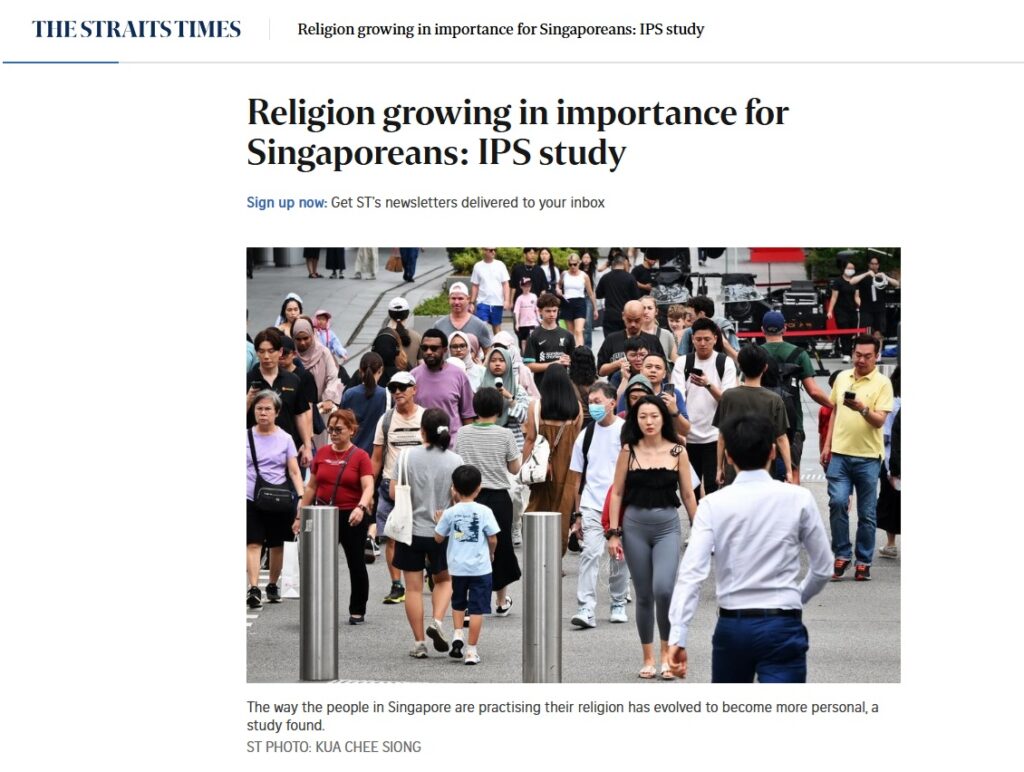
On 20 Aug, the Straits Times published a report titled “Religion growing in importance for Singaporeans: IPS study” (20 August) on religion becoming a more important part of Singaporeans’ identity in recent years, according to latest findings by the Institute of Policy Studies (IPS).
 |
The Straits Times’ summary are as follows:
1) Singaporeans increasingly view religion as vital, influencing their perspectives, as shown in IPS surveys (2013, 2018, 2024) with spirituality giving meaning to life.
2) Religious practices are evolving; more Singaporeans are engaging with religious media and individual practices like meditation, while fewer attend gatherings.
3) A stronger religious identity could lead to groups seeking greater influence in policymaking, requiring careful management to maintain religious harmony in Singapore.
The Humanist Society (Singapore) views are as follows:
On 1), Singaporeans increasingly view religion as vital, as shown in IPS surveys (2013, 2018, 2024).
Based on the Singapore census, the share of residents with no religious affiliation rose to 20% in 2020, up from 17% in 2010, and 15% in 2000. Detailed census data in 2020 also shows non-religiosity is more pronounced among younger age groups. For example, 24.2% of those aged 15-24 reported having no religion, compared to 15.2% of those aged 55 and above.
So it is not true that, for Singaporeans as a whole, religion is growing in importance. It may just be growing among those who are already religious. It is important that this nuance is captured, as the non-religious form a significant proportion of the resident population. They should not be forgotten.
On 2), religious practices are evolving; more Singaporeans are engaging with religious media and individual practices like meditation, while fewer attend gatherings.
Meditation is not necessarily religious. Sam Harris, the American philosopher and neuroscientist who wrote the book The End of Faith (2004), is one prominent atheist public figure who supports meditation. Over the years, he is a promoter of meditation practices without the need for any religious beliefs.
On 3), a stronger religious identity could lead to groups seeking greater influence in policymaking.
In an increasingly polarized world, eroding the secular nature of the state will not be good for Singapore. Religious fundamentalism can significantly impact policymaking, often leading to tensions between religious values and individual rights. In the United States, debates over reproductive rights and LGBTQ+ issues frequently involve conflict between religious beliefs and personal freedoms. Recently, in Malaysia, recent state policies like mandatory prayer attendance demonstrate the potential consequences when religious fundamentalism heavily influences governance.
We need to maintain balanced approaches that respect both religious diversity and individual liberties. And such a balance is not possible without secularism.
Conclusion
We need to uphold our secular common space and be inclusive of non-religious perspectives, which are crucial in ensuring that Singapore remains a harmonious, multi-faceted society.
Singapore’s strength lies in its diversity, and this diversity should extend beyond race and religion to include those who identify as non-religious. While we are a relatively silent minority, we still need to be heard, our concerns addressed.