Archives for September 2025

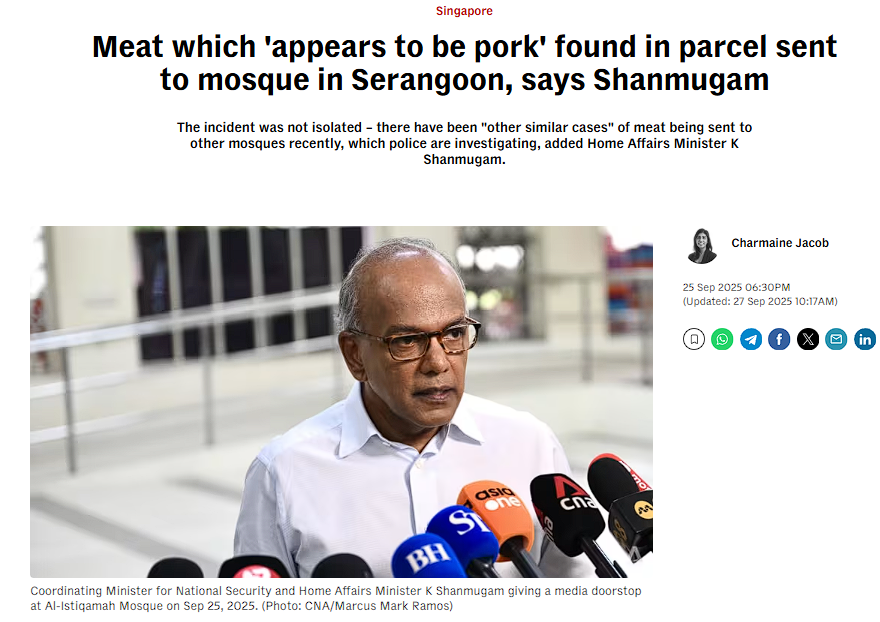
Humanist society Singapore’s official statement on the pork meat parcel sent to Al-Istiqamah and a few other mosques Singapore

1. The Humanist Society encourages a rational approach to human problems via informed and reasoned discussion of issues, backed by evidence and guided by compassion.

2. Reasoned discussion of issues is not possible when tensions are high between racial and religious communities due to deliberate inflammatory actions aimed at sowing discord in the country.

3. Recent actions by a Singaporean man to send an envelope containing a piece of pork with an offensive note to a mosque is deplorable. There is no value in such an action.

4. We support efforts to ensure a safe, stable and secular Singapore where freedom of religion is guaranteed and no person should be harassed just because of his/her beliefs.

Written by JY

Never Forget — Even in Singapore

Yesterday marked 24 years since the September 11, 2001 attacks in the United States — an event that cost nearly 3,000 lives, with ramifications that continue to be felt today.

As we honor the victims, we are reminded that violent extremism is not a distant threat but a continuing challenge, including here in Singapore.

Just this week, news broke of a Singaporean teenager being issued a Restriction Order (RO) for self-radicalization. Disturbingly, he drew from a “salad bar” of ideologies, mixing ISIS propaganda with far-left and far-right extremism. This shows how easily young people can be drawn into dangerous narratives online, where extremist content crosses borders and adapts to new contexts.

Self-radicalization remains one of Singapore’s security threats. Unlike the large terror networks, self-radicalized extremists often act alone, shaped by flawed assumptions and selective readings of history.

To stay committed to their cause, suppression of doubt and shutting down critical thought is no longer suggestion, but a mandate, making them vulnerable to manipulation and eventually, violence.

The risk is amplified in today’s polarized world. Algorithm-driven echo chambers on social media reinforce grievances and magnify anger, creating fertile ground for radicalization. If unchecked, these echo chambers can harden divisions and normalize extremist worldviews.

Thus proving why secular humanism and critical thinking are needed now more than ever. Humanism offers a philosophy rooted in both reason and compassion: the courage to question, and the empathy to care. While it may not dominate headlines like extremism, humanism quietly builds resilience by nurturing critical inquiry, dialogue, and expanding our shared humanity.

On this solemn anniversary, we call on Singaporeans to strengthen these values. Extremism feeds on hate and ignorance; our best defense is a culture of compassion and reason.

— Written by JY, Edited by Mel

Secular Assembly – 30 August 2025

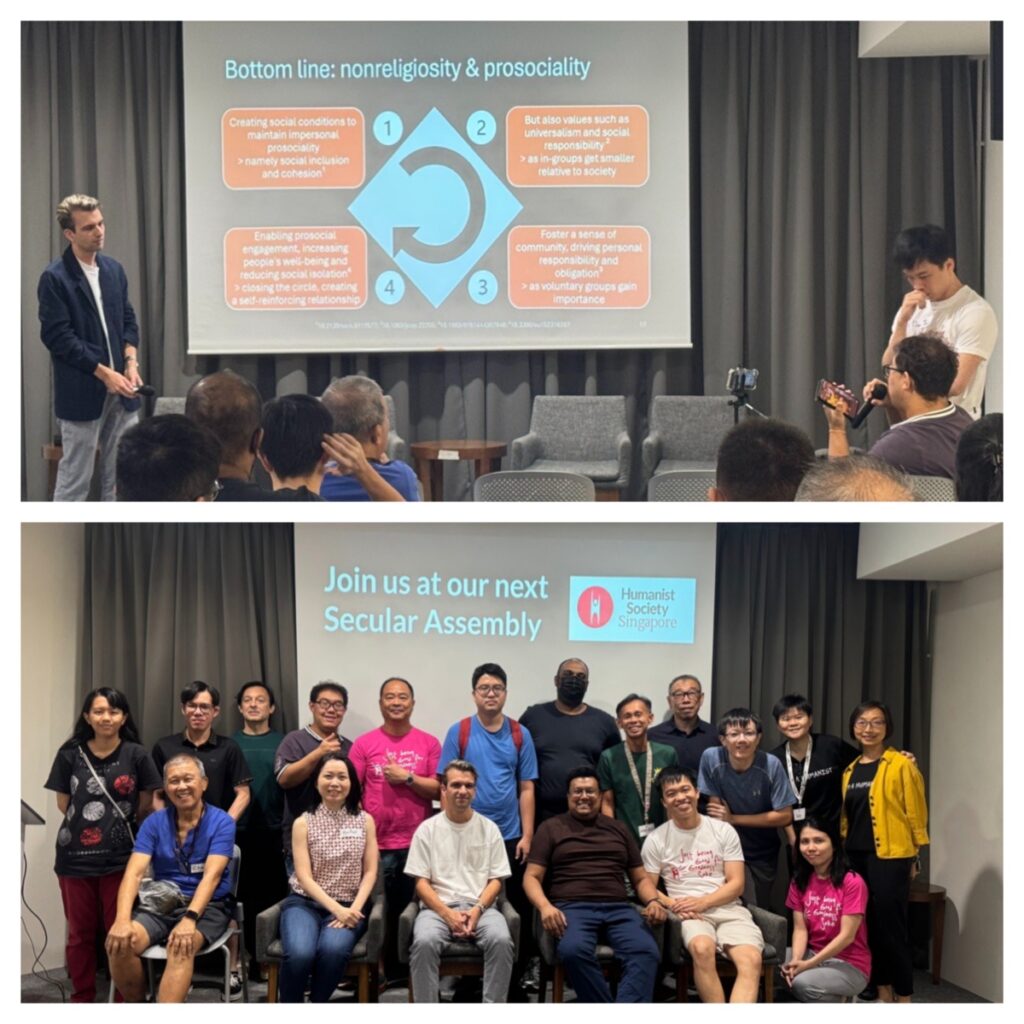
How can non-religious communities promote helping behaviour? Our seventh Secular Assembly of the year, held on 30 August, explored this question with compelling research insights.

‘The Rise of Nonreligion and its Perpetuating Beliefs’ was the subject of a guest presentation by Robin Weber, a member of our humanist community and a researcher. Robin began with various studies on global trends in religiosity and non-religiosity, highlighting the increasing prevalence of non-religious demographics around the world. He also shared surprising research about the religiously unaffiliated in Singapore, such as the Pew Research finding that 62% of non-religious adults in Singapore ‘believe in God or unseen beings’.

Indeed, even within the non-religious, there is a huge range of beliefs. As societies become increasingly diverse and secular, it’s important to ask what factors independent of religion can contribute to prosociality, or behaviour that benefits others.

Robin shared that at an individual level, these factors include self-compassion and empathy for others, as well as social support (the perception of being understood, supported and respected.) In fact, social networks are thought to be a generally stronger driver of religious groups’ prosociality compared with a belief in a higher power.

As such, for a secularising society to maintain impersonal prosociality (prosociality towards others outside of one’s in-group), a sense of social inclusion and cohesion are essential. With this foundation, if other-oriented values such as a sense of social responsibility are cultivated, a stronger community is more likely to arise and in turn bring about prosocial behaviour. 

In addition to Robin’s enriching talk, the Assembly programme included an update on the Society’s donation drive for Singapore Red Cross (we exceeded our $1,000 fundraising target!), and soul-nourishing traditions: a lively singalong and a guided mindfulness exercise.

Join us at the next HSS event, where we’ll continue to build the humanist community!